As a photographer, emulation like this is of great interest to me. Like in cinematography, film is often held in high regard in photography with the caveat that it isn't even remotely as flexible as digital options.
Have you considered creating a parallel product as an Adobe Lightroom plugin and/or a standalone app for still images?
I believe they have Adobe + Da Vinci plugins for film & video (and maybe a standalone app as well. At least they used to when I played with the beta, but it may be plugin-only now, I’m not sure).
As far as I remember, they try to do some physically accurate emulation as well. The founder is a big fan of film photography and also runs some interesting gigs (like, repackaging cinema film for use in still cameras) - also blogs about color and film photography.
> [film] isn't even remotely as flexible as digital options
I've pretty much only ever shot film, so my opinion isn't worth much, but colour negative seems to be way more flexible than digital if all you're talking about is the capture. In terms of using film in modern workflows, digital is easier.
I just tried to bend my CMOS sensor around a film spool, and can confirm. Film is more flexible...
More seriously it does depend on your definition of flexible. Being able to switch speeds (ASA numbers) without having to replace the film or carry multiple cameras is a huge flexibility win for digital all on its own.
Besides dynamic range, that’s a real stretch to say color negative film is more flexible. That sort of film arguably does a better job of preserving highlights, but I don’t see a plausible argument for any other aspect being better. Just getting the white balance right alone…
Film does not have more dynamic range than good digital sensors.
In the end, it's about faithfully recording which parts of the site got hit by photons. Digital sensors do that more accurately than any practically-sized strips of plastic with silver grains on them do. Both in terms of location (resolution) and amount (dynamic range).
It's true film handles blown highlights better, but not that much better, and digital handles underexposed shadows significantly better.
> any practically-sized strips of plastic with silver grains on
Which is quite subjective. I would say that a Mamiya 7, Fujichrome and drum scans easily match today's digital medium format. And I would say that 120 film is 'practically-sized.
4x5 transparency, good lenses and drum scanning is still unmatched in terms of overall image quality.
This is a discussion without many definitive answers.
But there is at least one: the resolution of 4x5 film easily exceeds any commercially available digital sensor, with pretty much any halfway decent lens.
Digital sensors also require collimated light, so digital lenses correct for this, where film can produce a sharp image from simpler lenses.
Additionally, I personally prefer the colour reproduction of film.
>the resolution of 4x5 film easily exceeds any commercially available digital sensor, with pretty much any halfway decent lens.
Theoretically perhaps, but you have to look at the whole imaging system (including the inevitable loss from scanning or optical printing in the case of film). Even five or ten years ago the best digital systems were able to capture about as much detail as you could realistically squeeze out of a 4x5 negative. If you disagree, I'd be interested to see some comparison shots backing this up. I shoot 4x5 as a hobby, but I've long ago given up any illusion that it has practical resolution benefits over the best digital equipment.
It's also worth mentioning that for realistic large format photography, accurate focus and camera shake start to become significant limiting factors. The actual experience of using a 4x5 camera (outdoors at least) tends to consist of taking your best guess at accurate focus while squinting at a dim ground glass through a loupe, and then hoping that you triggered the shutter at the precise moment when the wind stopped blowing.
Finally, one has to take diffraction into account. Typical apertures for 4x5 landscape photography are around f22-32. A good chunk of the theoretical resolving ability of the film and lens is lost once you're stopped down to that extent.
To match actual resolution of something like a PhaseOne 150mp sensor with 4x5 film, you need to be getting ~55lpm on film. Which is not difficult with decent lenses at working apertures.
Scanning the resulting negative or transparency at that res (~2800ppi) without any loss is also not difficult with a drum scanner. Not everyone has a drum scanner, sure, but then the comparison is between digital sensors and consumer scanners, not sensors and film.
I've measured image detail on drum scans of 6x9 Tri-X negatives I shot handheld, and as far as I can tell 40lpm was the lower bound of detail. So, I'm confident I could produce as 4x5 colour neg/transparency that exceeds any PhaseOne sensor in terms of resolution.
The theoretical resolution of the film itself isn’t the limiting factor, as I explained above. It’s things like camera shake and focusing precision. (Even if your focusing judgment is perfect - which it isn’t - you are going to move the rear standard to at least some extent when you insert the film holder; film holders and cameras are calibrated with a margin of error; and sheet film does not lie perfectly flat.)
I read so many posts online extolling the theoretical resolution of large format film, but these are almost never accompanied by actual comparison shots. I really think you might change you perspective on this if you tried using a 4x5 camera in realistic conditions (which it seems you have not?)
You can google for real world comparisons of 4x5 film and high res digital backs. There are very few such comparisons actually made, for all the confident pronouncements one can read in forums. Even 5-10 years ago, the resolution advantages of 4x5 were marginal at best in comparison to 50MP digital sensors.
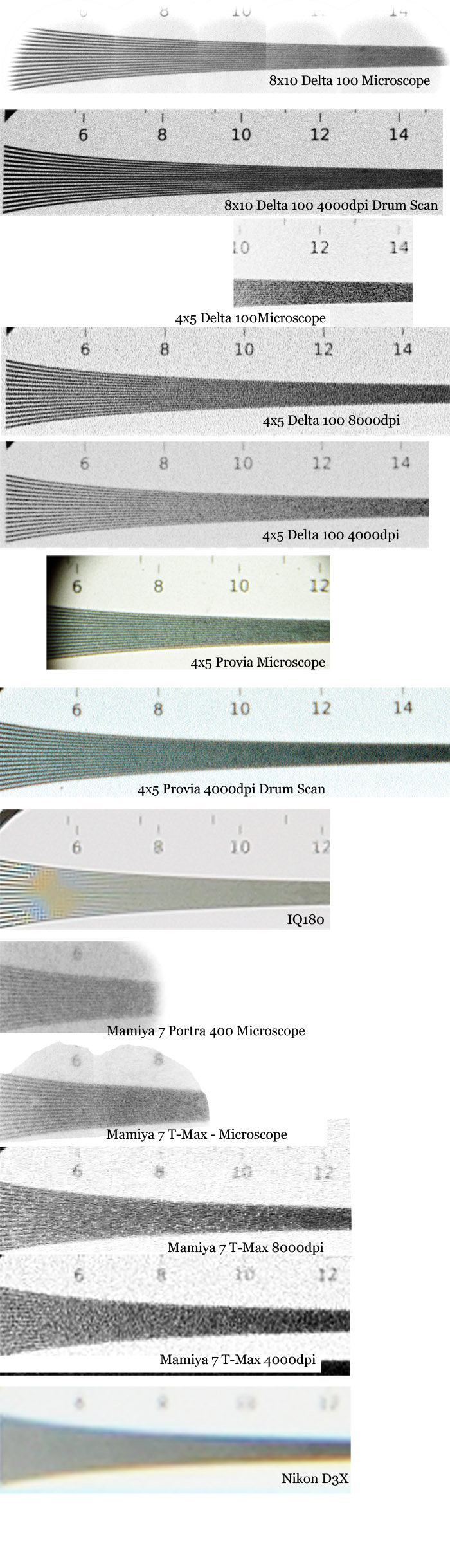
Given these results on 8x10, it seems highly unlikely to me that 4x5 film could offer any significant advantage over a 150MP digital sensor in practice.
Yes, well that test puts it to rest then. 4x5 is unlikely to offer any significant resolution advantage. Although, I do think there is an advantage evident in another of Tim Parkin's tests:
Comparing the 4x5 Provia & IQ180, the digital sensor detail degrades into a blue and yellow maze of perpendicular artefacts as the lines converge, where the film degrades more gracefully (in my opinion). The digital image (in this test) appears to produce an image that is not faithful.
It's reasonable to suggest that the graceful loss of detail on film offers a not-trivial advantage in high-contrast detailed scenes (especially high-resolution black and white films). In overcast low-contrast scenes digital clearly produces better detail.
Perhaps this maze-like tendency of some digital sensors is why people look at their film and think it's sharper or provides more detail.
It would be interesting to see a test of current 150mp sensors, perhaps this has been corrected and the advantage disappears, but maybe digital artefacts like the blue-yellow maze are just moved further right.
Yes, negative film is very tolerant of overexposure in a predictable way.
But I never shoot low-light scenes, and as far as I'm aware the inverse is true in circumstances where you're trying to extract as much as possible from limited light, ie. digital is more flexible when underexposure is a concern.
While this does answer the plain question, would you mind sharing any more details? Did you come to a decision, is there a planned release date, is there a way to subscribe to updates, etc? I'm saying all of this as a potential future customer of yours, I feel I shouldn't have to, for lack of a better word, try and force this information out of you.
+1 on this as well, been looking for something since VSCO Film sunsetted. Also open to any recommendations from other film simulation for photography too!
If you're down to try new systems you can pick up a Fujifilm xe2 for about 250$, plus a good prime for another 250$, then shoot jpeg + raw and play with Fuji's built in film sims and in camera raw conversion settings to get remarkably film like photos.
I basically don't edit photos anymore now that I'm with Fuji. It's not like I'm artistically opposed, the extra step was basically ruining photography for me, I simply don't have the time.
I still shoot jpeg + raw though because I may be lazy but I'm not insane :p
I do shoot with Fuji X-T30 sometimes, how did you know?! But mostly shooting with iPhone nowadays since it's always with me. Your links are awesome, I'll try them out!
I don't know if it would be good enought for you. But some cameras you can try to simulate film simulations (I own an X100V, but there are many options). It is not perfect but I love the results, one source material that I like is https://fujixweekly.com that have recipes for simulations for fuji, but there are some other resources for Ricoh and Nikon cameras.
It's the fact they're all dog slow that levels the playing field, at least for me! I have a 907X and it's a love hate relationship... Down to the log files being encrypted.
Indeed!
I have been really tempted by a 907x… Sad to hear they are so locked down. The IQ series has plain text logs at least!
And the IQ4 is linux…gpl… ;)
You do sound a bit rude. It’s certainly not a given. I know probably more than most here about DNGs and other image processing. Check my profile/websites.
I have a camera that shoots cinemaDNG, but I would not necessarily expect resolve to support a single dng frame. Plenty of dumb things out there, and no need to be snarky when someone learns something.


Have you considered creating a parallel product as an Adobe Lightroom plugin and/or a standalone app for still images?