To match actual resolution of something like a PhaseOne 150mp sensor with 4x5 film, you need to be getting ~55lpm on film. Which is not difficult with decent lenses at working apertures.
Scanning the resulting negative or transparency at that res (~2800ppi) without any loss is also not difficult with a drum scanner. Not everyone has a drum scanner, sure, but then the comparison is between digital sensors and consumer scanners, not sensors and film.
I've measured image detail on drum scans of 6x9 Tri-X negatives I shot handheld, and as far as I can tell 40lpm was the lower bound of detail. So, I'm confident I could produce as 4x5 colour neg/transparency that exceeds any PhaseOne sensor in terms of resolution.
The theoretical resolution of the film itself isn’t the limiting factor, as I explained above. It’s things like camera shake and focusing precision. (Even if your focusing judgment is perfect - which it isn’t - you are going to move the rear standard to at least some extent when you insert the film holder; film holders and cameras are calibrated with a margin of error; and sheet film does not lie perfectly flat.)
I read so many posts online extolling the theoretical resolution of large format film, but these are almost never accompanied by actual comparison shots. I really think you might change you perspective on this if you tried using a 4x5 camera in realistic conditions (which it seems you have not?)
You can google for real world comparisons of 4x5 film and high res digital backs. There are very few such comparisons actually made, for all the confident pronouncements one can read in forums. Even 5-10 years ago, the resolution advantages of 4x5 were marginal at best in comparison to 50MP digital sensors.
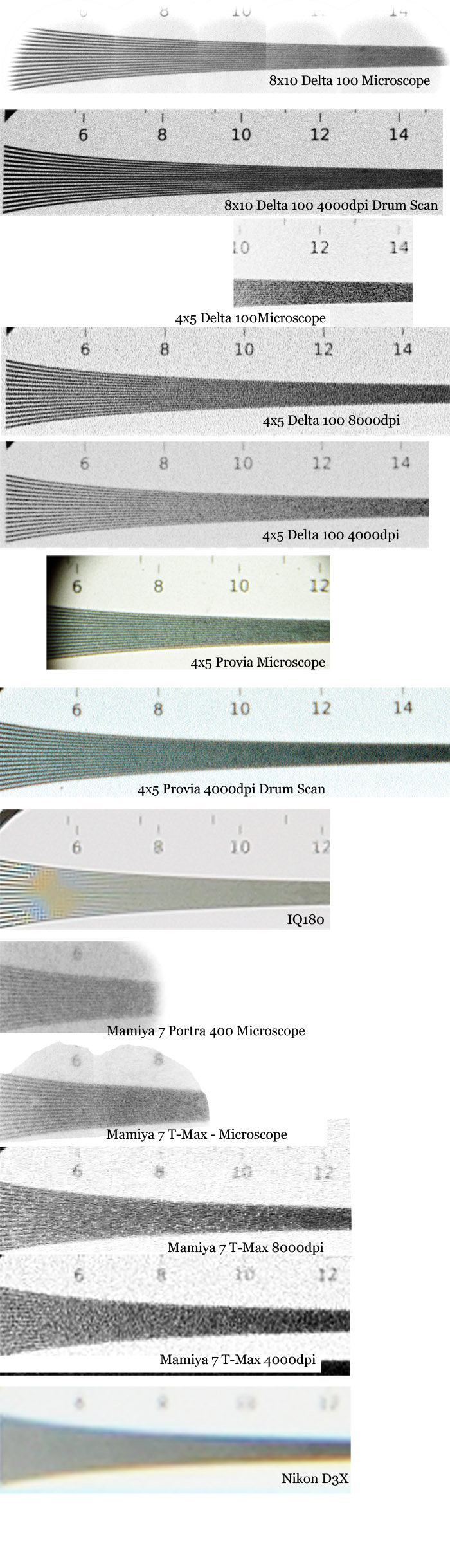
Given these results on 8x10, it seems highly unlikely to me that 4x5 film could offer any significant advantage over a 150MP digital sensor in practice.
Yes, well that test puts it to rest then. 4x5 is unlikely to offer any significant resolution advantage. Although, I do think there is an advantage evident in another of Tim Parkin's tests:
Comparing the 4x5 Provia & IQ180, the digital sensor detail degrades into a blue and yellow maze of perpendicular artefacts as the lines converge, where the film degrades more gracefully (in my opinion). The digital image (in this test) appears to produce an image that is not faithful.
It's reasonable to suggest that the graceful loss of detail on film offers a not-trivial advantage in high-contrast detailed scenes (especially high-resolution black and white films). In overcast low-contrast scenes digital clearly produces better detail.
Perhaps this maze-like tendency of some digital sensors is why people look at their film and think it's sharper or provides more detail.
It would be interesting to see a test of current 150mp sensors, perhaps this has been corrected and the advantage disappears, but maybe digital artefacts like the blue-yellow maze are just moved further right.


Agree 100%.
To match actual resolution of something like a PhaseOne 150mp sensor with 4x5 film, you need to be getting ~55lpm on film. Which is not difficult with decent lenses at working apertures.
Scanning the resulting negative or transparency at that res (~2800ppi) without any loss is also not difficult with a drum scanner. Not everyone has a drum scanner, sure, but then the comparison is between digital sensors and consumer scanners, not sensors and film.
I've measured image detail on drum scans of 6x9 Tri-X negatives I shot handheld, and as far as I can tell 40lpm was the lower bound of detail. So, I'm confident I could produce as 4x5 colour neg/transparency that exceeds any PhaseOne sensor in terms of resolution.