This would address an important element of high Bay Area housing costs: the discretionary project veto by local authorities. This is the main reason why only super-high end luxury stuff gets built in San Francisco.
In most parts of the US, there are certain local zoning laws. You apply to the local government for review of your project. This is expensive, as you must prepare detailed professional studies for the proposal.
If the project conforms to all of the zoning laws, it must receive a permit. They can only deny you a permit if your project does not comply with some specific zoning law.
In San Francisco and several other nearby cities, the local government can arbitrarily withhold a permit even when a project conforms to all local zoning laws in every respect, usually under the vague and arbitrary guise of "not fitting in with the neighborhood's character."
Since applying for a permit is an expensive and time consuming process, most developers simply don't bother to even try in San Francisco. They just go elsewhere, where their project can't be arbitrarily vetoed by local authorities despite conforming to all applicable zoning laws.
The main exception is luxury developments: since the profit margin on luxury construction is so high, it's worth the extra cost and risk associated with navigating San Francisco's permit process.
If this law passes, then municipalities will not wield the power of arbitrary veto anymore. There will still be extensive zoning regulations, of course; the difference is that development restrictions will have to be spelled out in the law, in advance, rather than made up on an ad hoc, per-project basis by local officials. This greatly reduces the risk involved in starting a development project, and makes non-luxury developments much more likely to be profitable and thus undertaken by developers.
Economics are the reason high end housing gets built. The fixed costs of development are similar regardless of affordability. Assuming uniform margins gross profits are higher at the high end as are internal rates of return [due to constant fixed costs].
Going further, there's more money to be made on larger loans and hence incentives for any developer financing purchases. Easier to sell on mortgages backed by higher quality assets.
Affordable housing development is a specialty. It requires relationships with politicians willing to forgo maximizing the property tax base, specialized lenders, and a unique deal flow pipeline. E.g. think about the attractiveness of the 30 year affordability requirements in the legislation to the commercial market.
Anyway, the effects of legislative changes will be felt ten to twenty years out...many of the shovel ready projects funded by the stimulus are still under construction.
This is the correct answer. Labor and materials costs, nationwide, exceed $300 per square foot (and often much higher) for a high-rise project [1]. Once you factor in efficiency, land, insurance, financing, sales and marketing, and all of the other costs of a project, it's difficult to make a profit until costs start pushing the $1000/sq.ft. range. That's luxury housing.
However broken SF's development process may be, it isn't the limiting factor to new development. SPUR estimates the regulatory costs for a San Francisco project at about 20% of the total costs [2], and most of that is the low-income housing set-aside (which is ~10-15%, varying by project). The majority of the costs of any new project are land, labor and materials. And San Francisco truly is an exception, in that it's one of the few cities in the world where there's no more undeveloped land.
People love to make generalizations based on community meetings (which are always a circus, in any city) and the cost to do a bathroom renovation or alter a garage door, but to a large construction project, these kinds of bureaucratic costs are a fixed expense. Land, labor and materials drive everything.
Edit: I'm stating facts here, and citing sources for those facts, directly from developers. I have no idea how you can downvote factual information. If you want to have a reasonable conversation about housing in SF, you have to take these basic economic questions into account. They matter.
"The majority of the costs of any new project are land, labor and materials."
That's highly misleading, because if development gets easier then rents go down, and if rents go down then land prices go down. The paper at http://faculty.washington.edu/te/papers/Housing051608.pdf estimates that excessive regulations are responsible for half of San Francisco's housing costs. That was in 2006, so it's almost certainly more now.
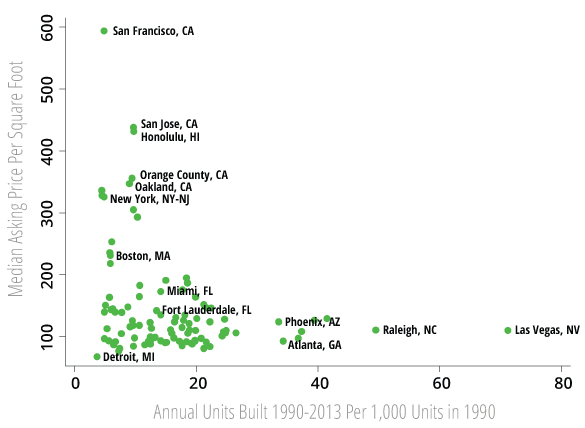
"The data shows, clear as daylight, that prices are only ever this high in cities which refuse to build any new housing"
That graph shows only that housing is more expensive in cities that haven't built a lot (it's actually not clear, since there's no R^2, so you can't interpret it). It doesn't tell you anything about why those cities haven't built.
"In Houston, which famously has no zoning, you can buy a condo in a downtown luxury high-rise for $200 per square foot"
Houston is over 600 square miles, with few geographic impediments to construction. San Francisco is 50 square miles, surrounded on three sides by water. There's a latent variable you're ignoring.
"That's highly misleading, because if development gets easier then rents go down, and if rents go down then land prices go down."
Development doesn't "get easier" as rents go down. It gets harder, because it's harder to justify the costs of a project to investors.
The $300/sq.ft. estimate is a nationwide baseline estimates for high-rise construction. They're labor and materials costs, and are unrelated to land, rents, local policy, etc. High-rise construction becomes especially difficult as rents drop, which is why you don't see it outside of the most expensive markets in the world.
"Downtown San Francisco is full of undeveloped surface parking lots. Here are some maps I made..."
Highlighting every parking lot you see in SF (which is what you've done here) isn't a counter-argument. They're land that is being used for a current economic purpose (unlike, say, most of the land surrounding Houston, which is being used primarily for jackrabbits and snakes).
In fact, you've highlighted a number of lots in my own neighborhood that are currently in the process of being developed. Why weren't they being developed before? It wasn't worth it until residential demand in the neighborhood went up. You're assuming that these lots weren't developed "because regulation", when the answer is "because nobody wanted to build there".
"The paper at...estimates that excessive regulations are responsible for half of San Francisco's housing costs."
As far as I can tell, it's not a reliable source. It's a paper about Seattle, which runs a regression based on a small sample of land-use restrictions from a Wharton database, and claims (without proof) that regulations added $409,000 to housing costs in SF from 1989-2006. Aside from not passing the data analysis smell test, that number includes all regulations -- including state and zoning restrictions, many of which are perfectly reasonable.
The numbers I'm citing are directly from SF developers, via SPUR. It's possible that "unreasonable restrictions" drive up land prices more generally in SF, but you'd need a better analysis than this to prove it.
I don't necessarily dispute this, but your putative arguments could be applied to lots of industries, and seem inconsistent with the wide range of quality / price points for most products.
Real property is, in some meaningful ways, different from goods and chattels. It can be improved but not manufactured and of course cannot be relocated. It doesn't matter how much demand there is, some new real-estate entrepreneur isn't going to disrupt Palo Alto with $150,000 detached single family homes.
In so far as real-estate is a product, differentiation between quality and price points is primarily a function of location...as Peter Thiel might put it [but probably doesn't], each lot is a monopoly. There is cheaper housing in Detroit and solely based on the opportunities afforded by location and not necessarily the nature of improvements one might deem it of lesser quality than a similar structure in San Francisco.
Anyway, I've been involved in a bit of housing development over the years. The few developers I know who do affordable housing specialize in it [as the many upmarket developers do in the upmarket]. Developers who don't specialize in affordable housing typically don't do it. The market analysis and proper institutional investors are not orbiting the market rate housing and general commercial development herd...and most developers stick to their track record.
Yes, real property is different from goods and chattels in meaningful ways. But I don't think your initial arguments for a dearth of affordable property exploit on any of them.
In California newspeak, "affordable" housing means government-subsidized housing, while "luxury" housing means any housing built for profit (even if it's tiny studio apartments).
> In California newspeak, "affordable" housing means government-subsidized housing, while "luxury" housing means any housing built for profit (even if it's tiny studio apartments).
This is false. Direct subsidies are one of many means used in California to achieve targets for affordable housing, but affordable housing does not mean subsidized housing. That's particularly important in the context of this proposal, a key part of is proposing additional non-subsidy mechanisms to encourage affordable housing (by reducing the local-review barriers to new developments which include it, and reducing regulatory barriers to new units on existing lots.)
IME, that's how the word affordable is always used; do you know of any counterexamples? SPUR had to come up with a new term, "affordable by design", to distinguish housing that was built to minimize construction costs from housing that was government subsidized (http://www.spur.org/publications/spur-report/2007-11-20/affo...).
When bills like this talk about "affordable" housing in new developments, they don't just mean "the rent in this unit has to be kept below $X per month" (as in rent control). The "affordable" units are turned over to a government agency, such as the Mayor's Office of Housing in San Francisco (http://sfmohcd.org/), which administers them and decides who gets to live in them. For example, last year, the city of San Francisco decided that people who lived in the same neighborhood as a building would be first in line for that building's affordable units (http://www.sfexaminer.com/affordable-housing-lottery-being-t...). The building owners' approval was not required, because the program is run by the city.
> IME, that's how the word affordable is always used; do you know of any counterexamples?
Well, the most relevant counterexample here would be the California Health and Safety Code Sec. 50052.5 [0], which provides the cost-based definitions of "affordable housing" which apply to various income tiers (which are also those relevant to the present proposal from Gov. Brown.)
(These definitions are often prerequisites to certain subsidies, but it is meeting the definition, not the subsidy, that makes it "affordable housing".)
> The "affordable" units are turned over to a government agency
Proposals (including the present one from Gov. Brown [1]) conditioned on a certain share of affordable housing usually require that the developer make a commitment that they will meet the applicable cost-based definition of "affordable" for a period of time, and that that commitment will be enforceable by a public agency (the present proposal requires that this be done by the developer recording a land-use restriction enforceable by the public agency.)
This does not require that the property be turned over to (or even managed by) a public agency, though certainly there are affordable housing developments that have occurred where there was either direct ownership or management of the units by a public agency, nor does it require that the housing be subsidized in any way (though at the "lower income" tier, the population for whom they are targeted to be "affordable" to is also the population eligible for Section 8 housing subsidies, I believe.)
You point to two cases where the legal definition of "affordable" doesn't refer to subsidies, but don't the large majority of those units, in point of fact, enjoy subsidies? Your precision is helpful, but apsec112 could still be basically right. ("California newspeak" clearing referring to the way words are typically used, not legal definitions.)
FWIW, I have never understood "affordable" housing to have that connotation.
In my experience, as appears to be the case here, local governments often "encourage" developers to offer below-market-rate housing as part of the residential zoning rules. Here's an example: http://gothamist.com/2015/12/18/de_blasio_zoning_affordable....
I would add a little to this: It only holds true if there's nearly endless demand for high end units relative to supply. In SF, Manhattan, London, and other major cities this is true. There will always be a bunch of rich people willing to move in and pay high rents.
Otherwise, your logic implies developers in a place like Houston should only build high end units. That obviously doesn't make sense.
What would stop a municipality from making zoning laws that are impossible to meet, and then just issuing waivers to those that play the political game well enough?
Hopefully the local interests who also know how to play the political game well enough but recognize the "indications that businesses and residents are fleeing the state in part because of high housing costs and the state's Legislative Analyst Office blaming excessive restrictions on development for the affordability crisis".
Profiting from pulling out the rug to newcomers only works if there are enough newcomers still willing to pay the exorbitant rents for the artificially suppressed supply. If enough people start saying "eh, the bay area is nice and all but not worth it", the NIMBYism starts to get less profitable. Sort of a pendulum-swinging-the-other-way dynamic-equilibrium type of thing.
I don't know about that. Ignoring the rest of the world for a moment and concentrating on industrialized nations, we seem to be the worst at providing socialized services.
I've been out of the states for 10 years now and have noticed the motto being applied in states as altruistic as Switzerland, and it definitely rules in here China, much more than in the US.
China is a third-world country not comparable to western Europe. It's industrializing rapidly, but no one would ever be so naïve to think it has social services even approaching those in western nations.
China is comparable, but further down the development chain. Social safety nets and good governance tempers selfishness a bit, but can't eliminate it (e.g. Switzerland). America has less of a net and equality than much of Europe, which is why selfishness seems to be more apparent there than in Europe.
No, China isn't even remotely comparable. Just a few decades ago, it was a mostly agrarian economy. They've had massive industrialization in a very short time, but they don't the much longer-term culture of industrialization and social programs and worker protections etc. that western nations have.
And how exactly is Switzerland "selfish"? They may not be part of the EU, but they appear to have just as many social safety nets as any other western European nation. This seems like a rather silly charge to me.
My guess is that that would be a tougher law to pass. The real estate developers and construction trade unions would pretty much swear to block something that extreme.
It could also wreak havoc with small-time landlords who want to improve their properties, so that's another interest group that would militantly oppose it.
This has already happened in SF. You need a permit to install a new garage door on your house, including a review of how well it fits the neighborhood character (in the subjective opinion of the reviewer).
Yes, the real estate developers and construction unions have screamed, for decades. It passed anyway.
In the 1960s and early 1970s, the San Francisco city government was run by pro-development Republicans who built some admittedly rather monstrous looking concrete slab modernist skyscrapers downtown.
(Contrary to popular belief, it was then a rather conservative city, not some sort of mythical artsy bohemian paradise. The "freaks," as they were then known, were a small minority of the population.)
This led to an anti-development backlash against the so called "Manhattanization" of San Francscio, which synergized with general anti-capitalist sentiment brought by the large number of leftist newcomers who arrived in the 1970s. The pro-development Republicans were routed entirely out of city politics by 1980, and rent control as well as a number of highly restrictive zoning laws were passed, aimed at preserving the picturesque postcard hillsides and views of the bay and halting all forms of physical and social change in the city.
The result is that most of the city has a "frozen in amber" feel to it. Making any substantial changes to the way anything physically looked circa 1950 is simply forbidden.
If you have to do repairs, you must demonstrate how it will not alter the appearance of the building. You must preserve the facade identically to the way it has been. You can often see gut renovations where the original facade is propped up on wooden stilts facing the street, and the entire rest of the house has been torn down to be rebuilt.
A current case in the local news revolves around the city granting landmark status to a 60 year old pine tree (not even a rare species) in some guy's backyard, so that he is legally unable to remove it: http://www.latimes.com/local/california/la-me-san-francisco-...
Right. Another aspect of this is that SF is one of the few cities where minority groups have been able to use housing laws effectively to try and prevent them being kicked out of the city as prices rise (in most other American cities, these actions have failed). Look at the Tenderloin or Chinatown. This creates a pretty difficult where mostly poor minority groups feel like they have to be anti-development, because otherwise they won't be able to live in the city anymore. In theory given enough building and enough time, prices will go down and SF could be diverse again, but most people think that would be along time. It's a compounding situation of bad choices.
I also think you're giving short shrift to the effect that Milk's and Moscone's assassination had on city politics. It heightened everything that was going on elsewhere in the late '70s - the rise of the environmentalist movement, urbanism, increasing power to minority groups.
I would also say that a lot of the blame belongs to the cities outside of SF: SF only has 11% of the total population of the Bay Area and most of it's suburbs are even more anti growth then the city itself, they just hide it better by being zoned for single residency housing.
Very true about this being a regional problem. San Francisco is doing a poor job building more housing but the suburbs are actually far worse, such as mountain view allowing more office space to be built but no new housing.
Landmark status for a tree is rather unusual even in San Francisco. I don't know what would happen if this specific tree were damaged by a storm. My guess is they'd allow its removal and require that it be replaced by another one, but who knows.
Storms are not common in San Francisco, but they do happen occasionally. We usually get at least one or two good thunderstorms with high wind every winter.
Hah, I know that tree. The picture they used does not do it any justice. Its a beautiful tree. The lot is at end of the dead end street off Geary. Interesting one - double or triple size with main house and old carriage house on it, both set way back, unusual for that area and pretty. My guess is, it was bought to be torn down and build a couple multi-million townhomes side-by-side. Suppose it was easier for those guys to protect the tree than the home, carriage house or parcel itself. Is it that big of a loss of very unaffordable housing in grand scheme of things? The developer would not do affordable apartment building, even if it was zoned, the profit is just not there. I'd take that tree anyday over new small home. Looked at it every time I walked by it.
By the way, one fact thats rarely mentioned, that makes it far more profitable for developers to build small structures in sf is the earthquake code. Once you get over three stories, its totally different and far, far more expensive from time, engineering and materials standpoint. Dont get me wrong I'd love to see the city grow in height over some areas such as along Lincoln dr, its just not as simple as only zoning or nymbd blocking everything.
Harder to build -> harder to densify -> homeowners reap appreciation.
If you don't need work done, this is a great way to sit back and let your property values skyrocket (as long as you can pay property taxes, but I hear that's kinda sorta not a problem in California).
Existing homeowners don't usually oppose new development in order to maximize their property values. They are usually more motivated by quality of life issues. Some people specifically chose to live in low-density suburbs in order to have a little space, privacy, and quiet. It's hard to convince them to put up with more noise and traffic congestion just so that newcomers can have cheaper housing.
What percentage of home owners are people who have owned their house for a long time (to benefit from prop 13), need zero work done (unlikely if you've owned your house for a long time), and whose behavior can be reduced to a financial equation?
My guess is that a lot of people do interior work without permits. If you're tearing down an interior wall and re-building a bathroom, there's no evidence of that from outside, so no simple way for the city to stop you.
There is tons of this in SF, notably the huge number of illegally built "in-law apartments," where someone converts their garage or basement into a seperate dwelling unit without permits.
This is essentially what San Francisco does now: "fitting in with the neighborhood's character" is impossible to meet, unless you play the political game well enough.
Local real estate interests and the lack of political will. Sweeping zoning changes are hard work over many years. Those that widely devalue property? Few local politicians have the charisma to ride out multiple elections with that sort of agenda.
Philadelphia allows any individual member of city council to veto any construction project for any reason[1]; it's called "councilmanic prerogative", and it is unsurprisingly linked to a number of corruption cases as well as some very murky cases of political retribution[2].
I think Municipalities should have the power of arbitrary veto. As a resident of Sunnyvale I do not want more housing projects to come in Sunnyvale, this helps me keep my property prices higher, have less traffic, less people and less crime. Also high income people tend to also improve the quality of public schools.
I do not want state government to arbitrary force their views on our cities. Let the cities decide for themselves.
> The main exception is luxury developments: since the profit margin on luxury construction is so high, it's worth the extra cost and risk associated with navigating San Francisco's permit process.
And by navigating arbitrary decisions, I assume we're talking about bribery at some level of the process?




In most parts of the US, there are certain local zoning laws. You apply to the local government for review of your project. This is expensive, as you must prepare detailed professional studies for the proposal.
If the project conforms to all of the zoning laws, it must receive a permit. They can only deny you a permit if your project does not comply with some specific zoning law.
In San Francisco and several other nearby cities, the local government can arbitrarily withhold a permit even when a project conforms to all local zoning laws in every respect, usually under the vague and arbitrary guise of "not fitting in with the neighborhood's character."
Since applying for a permit is an expensive and time consuming process, most developers simply don't bother to even try in San Francisco. They just go elsewhere, where their project can't be arbitrarily vetoed by local authorities despite conforming to all applicable zoning laws.
The main exception is luxury developments: since the profit margin on luxury construction is so high, it's worth the extra cost and risk associated with navigating San Francisco's permit process.
If this law passes, then municipalities will not wield the power of arbitrary veto anymore. There will still be extensive zoning regulations, of course; the difference is that development restrictions will have to be spelled out in the law, in advance, rather than made up on an ad hoc, per-project basis by local officials. This greatly reduces the risk involved in starting a development project, and makes non-luxury developments much more likely to be profitable and thus undertaken by developers.