Except that that statement is not true. They may not be approached by numbers proportionate to their beauty relative to the population, but they are still more approached than any less beautiful.
Approaching extra-beautiful women in person, on the other hand, can be intimidating.
The okcupid data and your last sentence contradict your first paragraph. I was over-reaching when I said "not approached by very many men", but okcupid's data implies that there exist women A and B such that beauty(A) > beauty(B) AND suitors(A) < suitors(B). This probably seems unfair to woman A, that her less attractive friend B attracts more men, due to the fact that men find A intimidating. But the fact remains that beauty and suitor count appear to be non-linear at the high-end of the scale.
That said, woman A and woman B are both probably approached by more men than a majority of other women, but their relative success is non-intuitive.
This shows that the most attractive people get more messages than those less attractive, uniformly. It does not provide evidence for the existence of "A and B such that beauty(A) > beauty(B) AND suitors(A) < suitors(B)".
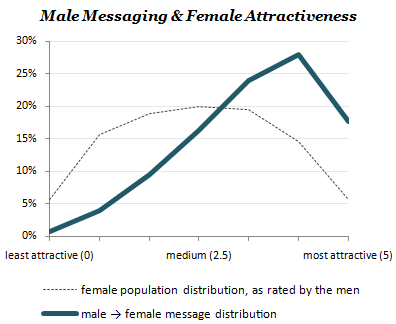
I think you're confused by the distribution graph:
But the "dip" on the right doesn't mean what you seem to think it does. If there were no dip, and the message distribution line had a uniformly positive slope, it would mean that the majority of all messages would be going to the most attractive women. The existence of the dip simply means that the sheer number of women with average attractiveness get enough messages to outweigh the tiny percentage who are most attractive in total number of messages.
My last sentence was about physical meetings; the rest of my comments were with respect to online messaging on dating sites like okcupid. In other words, I was suggesting that the old wives' tale may have more truth with respect to face to face than online.


Approaching extra-beautiful women in person, on the other hand, can be intimidating.