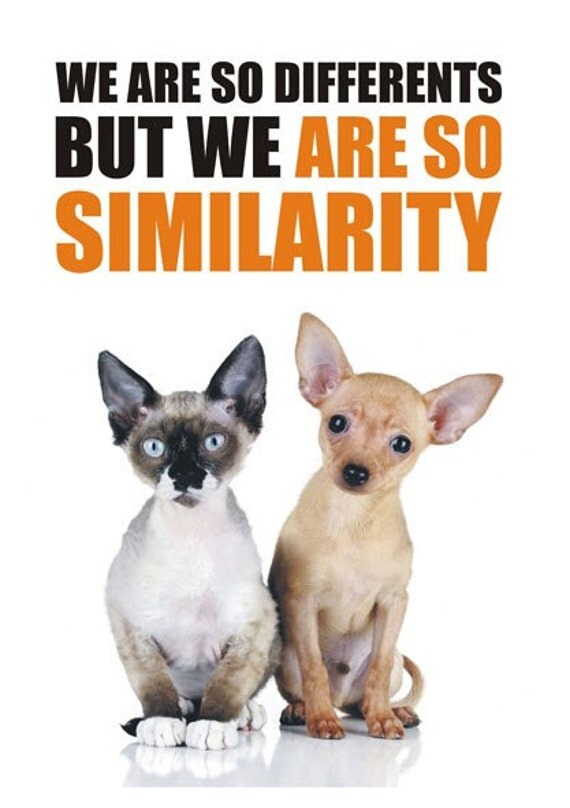
So narrow and so useless. What exactly are dogs? Almost all cats look the same and are almost the same size. But dogs? Dogs vary greatly in size, and looks. some of what we have accepted as dogs today, if you take them back to the past before TV/Computers, people back then won't recognize them as dogs, because of the looks or size. They would have to hear it back and behave like a dog to classify it as such. if all they had was a picture, they mgiht very well refuse and reject say pugs as dogs. so an algorithm to distinguish dogs from cats without context (behaviour, sound) will be more difficult.
Congratulations, you've just dramatically simplified the algorithm. This means that once you can identify a cat, you can say that any image which isn't a cat is most likely a dog.
Also, cheer up! This isn't supposed to be "useful". Who cares if it's narrow and can't be applied to anything else? It's a chance to have a bit of fun and for some people (like me) it's a chance to learn about image recognition techniques.
While true, I think that's besides the point. If you surveyed random people I bet you could get them to agree on whether an animal is a dog or a cat 99 times out of a 100.
How do you calculate size of something without reference? For all you know that animal is 200 feet tall. You could use shadows I guess if they were standing outside and you knew their location and the date and time.
Oh, and the fact that some dogs are small and some cats are large.
But otherwise, I think you're on to something. Something that won't work, but it's something.
>if you take them back to the past before TV/Computers, people back then won't recognize them as dogs, because of the looks or size. They would have to hear it back and behave like a dog to classify it as such. if all they had was a picture, they mgiht very well refuse and reject say pugs as dogs.
my dog without using TV or computer (at least to my knowledge as i don't know what he is up to when we are not at home) easily recognizes other dogs of all the different breeds and sizes from the distance like across the street, etc...
I've found that to be amazing. Given the differences between a Great Dane and a Chihuahua¹, how do dogs identify them as being another dog at a distance? They're vastly different sizes, they have different ear shapes, nose/face shapes, tail shapes, gait, and coat.
¹ There's argument that they're now different species, since they can no longer successfully interbreed -- for purely mechanical reasons.
when another dog is inside a car that just stopped at the intersection?
Another issue here is that smell of different dogs is supposed to have at least some variation as well (is this feature variation bigger or smaller than variation in size?), and if one dog is downwind then another is upwind - i.e. while smell obviously plays a major role in dog's sensing of the world we just can't ascribe it all to the smell. In my experience visual recognition plays major part in many cases as well (note: i'm not arguing which dog's sense is strongest, only that there are situations when visual is basically the only one that could have brought the information)
So perhaps a more exciting problem is "cat, dog or nither"? As you described it, it really only makes sense to solve this problem by solving only for cats, and then assuming all other items are dogs.
Edit: to clarify, is it safe to say that because cats look mostly alike, they would be easier to recognize consistently? or at least a good place to start?
only to people i guess. Reminds me about experiment with chimpanzees having problem to recognize faces (face recognition is a sign of intelligence according to the human thinking about intelligence) ... well, until experimenters stopped showing human faces to the chimpanzees and started to show chimpanzees faces :)
It would be interesting to see whether well-trained AI would "think" that "cats look mostly alike" compare to say dogs as it is only artifact of humans perception and of how our perception propagates into the software what we create.
Cats look mostly alike in comparison to dogs. Although each feline has a unique face, the degree of variance is considerably higher in dogs.
This is mainly due to breeding. Dogs can vary between 8-80 lbs, depending upon breed - some will fit in handbags, others will barely fit into a car. Cats, on the other hand, have significantly less variation (between 8-25 lbs[1]).
Further complicating the problem is that we have bred some dogs specifically for facial features and shapes. An English Bulldog, for example, has a drastically different face than a Labrador.
However, the vast majority of cat breeds retain the same facial features and shape. Those that do vary (e.g, Siamese cats) differ by small amounts in comparison to dog breeds.
This is why building a "dog or cat" detector is reasonably straightforward (if it's not a cat, it must be a dog), but building a "dog, cat, or other" detector is far more complex.
you're talking about features important for human model of cognition. No arguing here - for most of the people, using the features you described (and for AI systems built by humans and using the same features), the cats would look more alike than dogs.
>However, the vast majority of cat breeds retain the same facial features and shape.
i had cats for many years and with time learned to see the difference, and i'm sure that some people like judges from cat shows would see even more distinction.
It is all about model of perception (and we naturally think and talk like our, human, model is the [only] model) and how well it is trained.
I think a more exciting problem is an animal recognition and classifer system. Dogs, cats, horses, It will recognize an animal or not an animal. It will classify all animals. It will for instance recognize pugs and group them together, it might not group them with dobermans, but it should group all dobermans together.