Living in Taiwan for most my adult life, and now Beijing, I've seen countless people play, but this is the first attempt to force it onto a western chess board I've come across. To be honest the degree of bastarization was a bit painful. Calling the horses knights is one thing since they're very similar in movement, but calling elephants "bishops"!? That's just crazy.
Also, the only time I've seen the game with no river is when Koreans play, and they have a number of different rules (elephant movement, naked kings, cannon vs. cannon, etc...)
If you want to actually play the game, you really need to know what the real pieces are. Just imagine how hard it would be for a Chinese player who learned the rules of chess to get a game if he replaced all the pieces with Chinese characters (as in xiangqi).
There are all kinds of free downloads for this kind of game. For English speakers who want to learn, I recommend Qianhong. It's free, it's got all kinds of tutorials and it's modular so you can replace it's weak built-in engine with much stronger ones, like the elephant engine:
It's also a bit more satisfying to capture (or literally, "eat") opponents using the checkers-like pieces, rather than the stand-up pieces in western Chess, IMO.
I love Chinese chess, it has an aesthetic which is much closer to my heart than chess. I like chess variants that still retain some the war-game feel, and this variant satisfy that.
I think a much better description of the game, and other chess variants, historical and modern can be found here: http://www.chessvariants.com
If you have no moves, you lose. (You only have a king left and can't move anywhere with it) I actually learned this first, so imagine my confusion when I played western Chess and someone told me now it's a tie!
The other big gotcha is kings cannot have a direct line of sight to each other. Unfortunately, this is how I inadvertently lost a game of western Chess because I had accidentally ported over this rule in my head.
I've always been quite intrigued by the game of Rithmomachy. It was quite popular and even rivaled chess in popularity during it's hayday. You begin to understand it's complexity when you realize that "Proper Victories" are achieved by creating arithmetic, geometric, and harmonic sequences with the pieces.
I see people playing this on the sidewalks all over Vietnam. Sometimes the board is the back of a pizza box. Groups of four or more men seem happy to huddle around a game for hours. I've never been much of a chess player so I haven't had the courage to try a game myself yet.


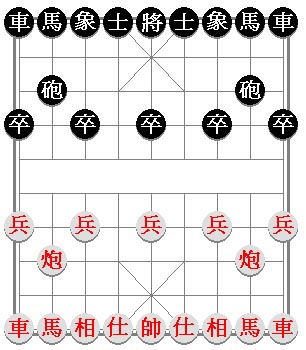
Also, the only time I've seen the game with no river is when Koreans play, and they have a number of different rules (elephant movement, naked kings, cannon vs. cannon, etc...)
If you want to actually play the game, you really need to know what the real pieces are. Just imagine how hard it would be for a Chinese player who learned the rules of chess to get a game if he replaced all the pieces with Chinese characters (as in xiangqi).
There are all kinds of free downloads for this kind of game. For English speakers who want to learn, I recommend Qianhong. It's free, it's got all kinds of tutorials and it's modular so you can replace it's weak built-in engine with much stronger ones, like the elephant engine:
http://www.techsupportalert.com/content/best-free-computer-c...