My grandfather worked at Exxon Mobile for 60 years and retired around 1988 with a few million dollars in stock. I remember my dad saying he had about 3 Million in stock he purchased as his retirement plan.
He built a house and bought a couple of nice cars living on about 100,000 a year. About 12 years ago he had a heart attack and stroke and was bed ridden. 12 years of doctor bills and hospice ate through almost every dollar he saved.
My grandmother sold the house and now lives on her social security. Maybe people 60 should not be so fast to go spend their cash. He was 72 when he got sick and 84 this year when he finally passed away. If something happens to our grandmother there wont be a nice $3 million to cover 12 years of hospitalizations and surgeries.
Whatever you save with your blood, sweat and tears (if you are lucky) will be blown on medical expenses. The trick is to convert to cash (literal), then give it to your wife, convert medical expenses to debt and die.
False dichotomy. There's a pretty big difference between dying after having a stroke that leaves you permanently disabled in your 70s vs. mandatory execution of healthy 40-year-olds.
There's a huge gradient between being a vegetable and virtually dead and suffering a minor injury that leaves you permanently crippled but in a way that isn't a big deal.
Where along that spectrum will you draw the line? Is that even possible to describe without being needlessly cruel, like someone who lost the use of both hands due to a stroke is killed but someone who lost the use of one hand and one leg gets to live?
These sorts of decisions should be left in the hands of those who are most impacted by it: The person in question. I'm a supporter of more dignified end-of-life options, of people being able to opt-out of life-saving treatment if they think it's not worth the fuss or the outcome is undesirable.
There's still a huge difference between someone electing to die with dignity because their cancer treatment has a 10% chance of delaying the onset by a few years, but a 100% chance of making their life a living hell for the duration, and someone who's told they're too ill to live and has their life abruptly terminated.
We should enable a culture where people are free to make that decision for themselves. California and several other US states allow for this - not sure about internationally.
I wouldn't want to live on life support. I'd rather my wife/kids get a nice (well managed) trust fund for the remaining savings and just go in peace early.
For people like this, it's always better for the free market to figure out how to deliver bad news to other people.
I had a coworker who was a hardcore Ayn Rand type who had a real harsh point of view like this, until his infant was born with a congenital heart defect that resulted in hospitalization for 3-4 months.
Frankly, my own experience gave me a similar perspective, although I was more "meh" on the issue. I had a serious back surgery at 25, and spent a lot of time in PT around people whose lives were falling apart due to expenses and lost wages. Meanwhile I had a great employer with generous benefits and leave. The trucker I was around was struggling to live with workers comp and disability coverage. He was selling most of his possessions to keep his house. It was chilling.
As a younger person having watched/lived through at least 3 members of my immediate family die with dementia/mental health problems, I lose more sleep at night over the prospect that euthanasia won't be legal and managed properly where I live by the time I get old.
I'm actually hoping that our shared generational suffering with respect to our baby boomer parents makes us get our generations' butt in gear and do something about it.
Got to use all that unnecessary suffering for something positive :/
My grandfather had a stroke two weeks ago. It affected 3/4 of the left side of his brain, which means he couldn't speak (except for 'shit', 'god damn', 'yes/no') and couldn't swallow. Or walk, obviously.
He told us repeatedly while he was alive that he didn't want to be put in a home. He wanted to cut his grass, feed the birds and be left alone - and after the stroke there was no way he could do that. We respected his wishes and opted out of the feeding tube, but he essentially starved to death. No fluids, no food for two weeks. Those two weeks burnt up all of his savings.
Everyone in my family agrees that it'd be better if assisted suicide were legal. No starving, no pain - just a nitrogen mask, and you don't even know you're dying.
Frankly, I find your 'older-and-wiser' posturing disgusting. Obviously it should be their choice, but today it's not their choice - the government says they must suffer and starve to death.
Basicplus appears to be responding to imgabe's second paragraph, which seems to suggest that euthanasia should be an obligation, not a choice.
The legalization of euthanasia raises some moral questions with respect to coercion and self-serving misrepresentation, but in cases like your grandfather's, where a decision has been made, those concerns no longer apply.
Perhaps I was vague, but I'm not suggesting we start murdering the elderly if that's what you mean. Like everything else in the world, we have a limited amount of resources to spend on healthcare. A disproportionate amount of them are spent extending the lives of people who have already lived a long full life.
If we have to choose between helping someone who's already lived 70 years live another miserable 10 years in a hospital bed hooked up to a machine vs. helping a 30-40 year old person overcome cancer so they can go back to supporting their family, we should do the latter first. Just thinking off the top of my head maybe we could accomplish this with pricing, by making end of life care more expensive and using the cost to subsidize care for younger people.
It's been legal in California for a year [1], though I'm not sure if your grandfather would have qualified (would his condition be considered terminally ill?).
Regardless, this is the way we should allow it. Eating up the savings of the dying seems particularly ghoulish when the wishes of the afflicted and their family are not respected.
Most countries with decent healthcare are reluctant to accept retirees. They'll likely have to fund their own health insurance, at least. If you can gain citizenship of such a country, well in advance of retirement, it could be well worth it though.
You can go to developing countries. The health care I received in Southeast Asia was quite good and the full cost was significantly less than just the co-pays on my plan in the US. Thailand has a retirement visa that allows for 6-month stays and you can live quite comfortably there for under $20k/yr.
I'm sure care is adequate in many developing countries if you get the clap or get injured in a car accident. But I'm skeptical you're likely to get as good cardiac or oncology care.
Not true. Retirees with generous pensions are a great opportunity for any country. They will bring money to your country without the need to produce anything. They won't consume a lot of public resources (no need of school or of police repression). They will reform a house, eat in your good restaurants, and enjoy all the services you can offer.
A lot of countries hunt for wealthy retirees, like Portugal and Australia. Sure you must have your health insurance.
Sure, they'll consume all the services you offer, and especially health care, as the parent suggests. But, yes, you need to have a generous pension, as well as meet another number of requirements that vary from place to place.
In order to emigrate and retire in New Zealand[1], for example, you need to
a) be healthy
b) bring your own insurance
c) bring ~$350k in savings and $40k annual income with you
The UK imposes an "independent means[2]" requirement, to prevent retirees from being a drain on the economy, as does Australia, Canada[3], etc.
> They won't consume a lot of public resources (no need of school or of police repression).
Either the host country's end-of-life medical care is not great by American standards (in which case what you write is true, but many Americans wouldn't care to move), or it is, and a retiree would consume considerable public resources. Unfortunately, there's no way to have it both ways.
There actually is a way: move to a country where the same level of care costs less even with no government subsidies. I think this would include most of Europe and the far East.
This is the result of central planning on the part of government. It allowed the AMA to do insane things like stopping new medical schools from opening for DECADES. It allows the AMA to continue to artificially limit the practitioners in all medical professions to keep wages high.
As a specific anecdote of the problem of government in healthcare: in my city a new children's hospital opened up a few years ago. The other area hospitals petitioned the government to not allow them to build the hospital until certain concessions were met. Among the concessions I'm aware of are not allowing the new hospital to own a medical chopper for 8 years. It was also not allowed to build a Level 1 trauma center. And of course that's after YEARS of not even being able to break ground while all this negotiating and concessions were being figured out. This type of interference raised the cost of healthcare for everyone in my city while likely decreasing the quality of care.
There's more to that story. Typically the problem is that there are too many hospital beds, not too few.
Outpatient treatment is increasingly more popular and more cost effective. Hospitals often raise costs by introducing massive capital costs that need to be amortized as well as other overheads.
With the exception of lower-cost, higher value primary care, there are rarely any meaningful access issues to doctors in metro areas. Those shortages are largely being addressed with PAs and NPs.
>Typically the problem is that there are too many hospital beds, not too few.
I'd be interested in a citation for this because it's counter to basic economic theory of supply and demand. If the supply outpaces demand, then the price should be going down, not up.
Medical services are a complex market. It's nonsensical to randomly apply basic economic principles without knowing what you are doing. (Good luck telling congress that) The smart thing to do is to make primary care more accessible -- you'd be able to close many hospitals and improve outcomes.
I see what you mean, but the over-priced beds are just a temporary phenomenon while smaller more agile competitors are killing the large facilities. In the end, cheaper service for health care is still being found from new competitors moving into the market.
Why does the government care what the other hospitals think? Would they stop a new burger bar opening too close to a McDonalds, if McDonalds petitioned them for long enough?
Yes, it's the way the world works. Homeowners vote against new developments (which decreases the cost of their homes). Everyone with a liquor license lobbies against more liquor licenses. Every grocery store lobbies against more grocery stores. Amusingly this causes big issues between state governments (who wants growth) and cities where most voters/business owners want to limit growth to protect themselves.
The cynical reason is because the hospitals are massive tax-bases and the owners of the hospitals are political donors.
The other reason is that the government has an interest in maximizing economic growth, among other things, which is why it has zoning power. Citizens in the area, including local businesses such as other hospitals, may raise any number of concerns about building projects. Further, any citizen (or corporation) can hold up just about any project for as long as it's willing to keep paying legal fees to fight projects based on trumped up bullshit about esoteric zoning laws that were written a century ago that they probably broke when building their own hospital.
> The trick is to move to a country with proper healthcare
The trick is to move to a country [where taxpayers are going to pay for your medical care]. Nice plan. Several people in this thread already noted that there are ways to make American taxpayer pay, without having to move.
Anyone who wants to test this assertion - that "fine healthcare" equal to what a wealthy retiree gets is available to all - should go to a nursing home that offers care for normal and purely medicare-supported patients.
You don't have to study the situation really closely to get what I'm driving at. The patients will generally stay in separate areas. Just walk around and use your sense of smell.
Or if you want actual truth, interview people at said missing home.
Person A was rich, her 500k in savings was all spent to provide her care at a rate of 5k per month until it is gone.
Person B had 100k to her name. She paid the nursing home 5k per month until it was gone. Then care is free until the money runs out.
Person C had 0 money. They paid $0 from day 1.
All three got the same medical care. All three got the same food. Maybe person A spring for a private room vs a shared room... But otherwise all would be the same.
Nursing homes in general aren't great. Hopefully you can stay out of them. Eating well and exercising seem to help. If not, money won't do much.
You do not know what you are talking about at all.
> Person B had 100k to her name. She paid the nursing home 5k per month until it was gone. Then care is free until the money runs out.
> All three got the same medical care. All three got the same food. Maybe person A spring for a private room vs a shared room... But otherwise all would be the same.
Person b experienced a lower standard of care once the money ran out.
(I'm sure this isn't universally true, but in my experience it is. It's a free market...)
Unfortunately, this is probably the best hack. Put assets in some kind of trust, then have the American taxpayer pay for those expensive last years. I am a pharmacist at a long term care pharmacy, and assisted livings in my area charge up to $8000 a month. Their model seems to be 1. Drain your assets until you qualify for Medicaid, 2. Move you from your private suite to a slightly shittier shared room. I believe Medicaid pays around $3000 a month. And that's only for a place to sleep and a med tech or patient care assistant be on site 24/7. Many of these places don't have nurses after 8pm. Do you want employees to give you your mess? How about an extra $500 a month?
All that money doesn't get you superior results. I talk to some of the more coherent patients all the time on the phone. The lonelier ones keep me on the line for longer. I can't help but think there is a better model.
I'm currently in a similar situation about what to do with an elderly relative with dementia who is currently in limbo after the last relative taking care of him died. The best moral option is to take guardianship and look after him. The best financial decision is to "divorce" from the situation and let the state take care of him so I have a chance of my wife and I being able to retire and saving for the kid's education expenses.
That's not necessarily the only option. Long-term care insurance claims to address this problem. (Whether it actually does or not, I'm not qualified to answer.)
Any time "insurance" is involved, be prepared to say goodbye to a good portion of your own health and sanity as you end up fighting with them over every little detail.
Honestly, the best argument for single payer is all of that bullshit is gone.
(Edit: never mind. I think there's some mistake in your chronology that renders my numbers invalid. Died at 84 in 2017 == born in 1933. Retired in 1988 at age 55, probably not after 60 years at XOM, more like 30; or retired after 60 years, probably more like 1933+18+60=2011. Guessing maybe he retired at age 60 in 1993? Got sick at 72 in 2005? Died at 84? The numbers change a bit--missed out some big gains in 1988 and 1989, hit the flat 2000s, and probably got creamed by having to cash a lot out during 2008 crash.)
What I was going to post based on your original report of retiring in 1988 with $3M (keeping it for illustrative purposes):
He must have sold the stock when he retired to buy that house and those cars. Had he kept it in XOM, his $3 million would have been worth $22 million today, with a dividend that would have covered his expenses and that kept pace with inflation.
Not that keeping your nest egg in a single stock would have been advisable, but the S&P return for that would have been comparable.
> Had he kept it in XOM, his $3 million would have been worth $22 million today, with a dividend that would have covered his expenses and that kept pace with inflation.
His house value probably rose at a higher rate than XOM's did.
Also, what's your point? His shares would be worth $22 million today and he'd still be dead.
The point is that his surviving wife wouldn't have to scrape by on social security, and that he wouldn't have had to have burned through his entire nest egg even if he was buying a house, cars, and spending $100K/yr + 12 years of medical expenses and long-term care.
But that's moot--the edit I made was because the $22M was based on a chronology problem in the original post. The ten year difference in retirement date from 1988 to 1998 is a much better explanation of the facts, and fits the OP's premise better.
I'm getting more and more convinced that one of the most important goals in live should be to mature to a level where you are simply comfortable with dying. Being able to simply conclude at one point in life that it's enough and either submit to fate or commit suicide.
And you will also realize that this is an unachievable goal. The kind of existence you require to attain that type of ease and thinking will alienate you from the vast majority of human behavior and thought.
I don't think that is true at all. It is neither unachievable as many people have achieved this already* - I don't see any reason why it should alienate me - I believe this state rather goes along with being more compassionate and empathetic - so I'd argue the opposite is true.
* to give you one random example coming to mind - the journalist in Mexico who got killed by murderers from a drug cartel past week knew very well what was at stake and chose to keep doing his job - so I'd argue he managed to come to terms with having to die. it's an extreme example but reaching this mental state is likely easier in less extreme life circumstances - those most of us are impacted by.
I disagree. I can think of multiple examples from my life of people who got to that point. Some I knew personally, others indirectly through people I knew.
Why did he not use his medicare policy? At 72 he would have been fully covered pre-Bush and would be covered in Medicare Part A & B post-Bush depending on the services.
When you get old, if you need skilled nursing care at home or in a nursing home, that's your dime.
Typically, you get admitted to a nursing home, spend all of your money, and when you run out go to Medicaid. Your county DSS will liquidate your home and remaining assets and you'll be paid for by that until you die.
If you have a surviving spouse, they get to keep some allowance.
Only in certain conditions. If you are recovering from a surgery, yes. If you need physical therapy at home, yes. If you cannot perform activities of daily living, or need more than 100 days of care, no.
Activities of daily living: "Activities of daily living (ADL) are routine activities that people tend do every day without needing assistance. There are six basic ADLs: eating, bathing, dressing, toileting, transferring (walking) and continence."
Fear? Seems more that there are simply no safe investments with decent returns, interest rates are abysmal. I think folks are 'hoarding' simply to not run out by the time they die.
Low interest rates are painted as great for the economy, but they amount to a war on savers and fixed incomes.
Oh, if we had high interest rates and inflation, people with fixed incomes and savers would be feeling horrible too.
The idea that there would be safe investments with decent returns is inherently ridiculous. The closest one can come is oligarchs buying tax policy, or baby boomers making sure that housing stock is inadequate so the prioe of the their home goes up artificially at the expense of the young and poor.
To me it seems that getting a decent return was a lot easier prior to 2007. Banks would pay interest rates of 6% or so and inflation was low. The stock market only gradually became overvalued.
Interest rates and inflation are linked. It's not very helpful to get a 17% interest rate when inflation is 16% (1970's in the US). Your real return is still only 1%.
they're linked, but it's far from the only variable in the system. Recent fiscal policy and results shows gov'ts have a hard time influencing real inflation with interest policy.
No, it ridiculous now in the bizarre fiscal policy environment that we were in.
You can look at historical bank interest rates from the onset of FDIC insurance. As recently as 2005 you could obtain meaningful returns on zero risk investments as a retail investor. I had a 10 year, 5% CD mature in 2015, for example.
$100 in January 2005 had the purchasing power of $122.55 in 2015. Having $105 instead ain't great. Your "zero risk" investment tied up money for a decade, and you had less purchasing power at the end of it.
Interest rates incorporate inflation expectations. What's bizarre now is the way we are playing footsie with deflation.
Fortunately, rates are annual and interest compounds. The end balance is $162.89.
For the cash portion of my portfolio, that's a good investment. If you're an unsophisticated investor, stuff like this or savings bonds are smarter investments.
Not just that, but I imagine (as others have noted) the fear of crippling medical bills is a huge part of it as well. America's heath care system has an uncertain future, and that may affect retirees' savings habits.
Savers like "money in a bank account" savers, or savers as in "I have a bunch of money I want to put somewhere, where does it go between ETFs/Real Estate/etc". Low interest rates are great for the 2nd group because of the insane asset price inflation we've seen in the past few years, especially in housing, which is the largest store of wealth for most old folks in the US IIRC.
The rates are low precisely because there is an oversupply of saved money. In other words, capital is so easy to get that nobody has to pay much interest on it. It's a borrower's market and will continue to be as long as we have the concept of "saving for retirement".
No. Businesses that generate cash export it overseas to avoid taxation.
The Fed basically makes banks maintain huge capital reserves, and allows them to borrow money for nothing. The banks don't pay for your money because the Fed is printing it for them.
Because they need to maintain these massive capital reserves, we get the benefit of printing money without circulating it.
There are two sides to every transaction, and whether low interest rates are good or bad depends on which side of the transaction you are on. Nobody is entitled to high rates on their savings.
I feel this is another down-stream effect of weak social support. If a country offers reasonable basic pension and healthcare, retirees will spend because they know if they run out of cash they have their basics covered. Without this support of course they will hoard money.
I saw this living in Norway where people in general tend to save less aggressively because they know if things go bad they are covered. And it worries me in my country of Australia where we are following the US model of ever reducing social services. It makes great short term savings but I feel there are these kind of longer term effects we pay the price for. And these effects are hard for many people to consider when its that far ahead so politically it is unlikely to change.
Healthcare is still so terrifying that I feel like I have to have millions of dollars saved up just in case. And the insufficient coverage we have now might not make it through the next two years unscathed.
I hear you... Like disappearing bulk billing GPs, specialists only agreeing to see you if you have private insurance and waiting times for public services exceeding the 1 year mark!
This is a really good argument for subsidized medical care. This fear of not having enough for medical expenses is perfectly reasonable, and I wouldn't fault sometime for hoarding cash for a second.
Solve the inherited inequality problem with inheritance taxes or guarantee medical care. Otherwise of course people will save for medical expenses. And they should, it's prudent.
Where I live, you still have to pay for opticians and dentists, and perhaps other medical treatments if you don't want to stay in a queue for a year or so.
The US option is full coverage for the indigent and partial coverage for the old.
If you need nursing care, you lose everything. Typically that means that when husbands get sick, the wife is left near indigent unless he dies quickly or the couple did estate planning with trusts.
Fuck. I'm 30, and I just went through this. I quit a bad job to try to do my own thing; after a few months without a paycheck - despite having plenty of saving six ways from Sunday - I clammed up almost completely, not wanting to spend a dime. I was miserable. It's the same feeling as item hoarding in CRPGs.
Seems like I either need to never retire, or set up a trust for myself so I have a guaranteed allowance. (Or deal with the implicated fear....)
This is tough, man. Some things I did when I was younger that helped me with this:
1) Go for a period of time (I did a month) living off of rice and beans (as far as I can find, the cheapest way to get close to a complete meal)[1]
2) Pare down everything in your life that isn't absolutely necessary. I put my bed in storage and lived in a hammock for a year. Cut out hot water for a period, stuff like that.
Once you do some of those things and realize that you can do it, living on a small income (or savings) in order to work on something becomes a lot easier.
I'm really lucky in that my runway is infinite, and a big part of it is because of the things that I listed. I know exactly how much the minimum I need to live off of is, I know what its like to live on that amount of money, and I know that it isn't scary.
[0]: A lot of the world lives off of this. I'm not saying that this is a path to complete nutrition. It isn't. Everyone should eat a balanced diet.
Hammocks are not a problem for the back just so long as there is sufficient tension in the strings and that the hammock does not hang too low. You sleep with your feet up - good after a day on your feet - and, because your body weight pulls the hammock straight, you have a very well supported and straight back.
Once in a hammock there is no 'swaying', the feeling is more like being in a flotation tank. If you have enough duvet, pillows, blankets and the like you can sleep in other positions and move with relative ease.
I badly pulled a calf muscle once and spent a fortnight getting back to strength, given the option of a normal double bed or a hammock slung above, I found at the hammock provided me with the sleep I could not get in the normal bed below.
Sadly I had to move from that attic room and I lost the anchor points needed for the hammock. I believe a hammock offers better support and comfort for a back.
In hammocks from Brazil you sleep diagonal to the "axis" of the hammock and your body is almost rod-straight. Your back will feel just fine after a night sleeping like this.
I agree, if America had real health care, people would be less apprehensive in taking time off and caring for their mental health.
Unfortunately voting in America doesn't really do squat. We're first past the post and the corruption runs so deep no politician can stand against the health care industry. Elections here are a joke.
* It is gerrymandered districts, setup over decades to guarantee seats go to one or the other party. The number of actually competitive elections is at historic lows every cycle.
* Representation per person is at historic lows. The population rises, but the seats in state and federal houses doesn't change. Even in the best case scenario, Wyoming still has over 250k people per senator. Nobody can actually represent the interests of that many people (albeit, given the original intent of senators they shouldn't, but that is a different can of worms). House seats are no better.
The information era has siloed people into ideological extremes. Coupled with the fptp disaster you pointed out, the corrupt media owned by centralized interests keep the poor at war with themselves.
* The obvious loopholes and exploitation of the constitution is blatant and apparent. Either anti-corruption clarification amendments are required, or a modernized rewrite maintaining the principles of separation of power and explicit rights and liberties but updated to insure things like freedom of privacy are necessary.
It is a chicken and egg problem to fix, of course. Regular people cannot rewrite laws or constitutions without the ample resources to wage a revolutionary war. However, the powers that be won't either, because the current rules set them up for power and give them their legitimacy. They are a product of the system as it exists and will fight to protect it, not change it.
Historically the best answer was to sail or caravan to the unsettled and unclaimed lands and try it over again, but we have run short on those options.
I use senators as an example, but it is hard to have representative democracy when you have no relationship with those you are meant to represent. I always bring up Dunbar's number[1] in the context of politics, because I have concluded that you can't have legitimate representation much beyond it. You can't care about your constituents legitimately as a limit of human psychology.
Without fail, every single state and federal representative today is representing on the orders of tens of thousands to millions of people per elected official. It is unreasonable to expect them to act in the will of their constituents when they have no way to know them as people and not figures. It is a fundamental fault I have always seen in democracy the world over, and think it is where the pressure from many people for direct democracy comes from, albeit misguided.
I realize lots of people find things like guaranteed issue and the essential health benefits milquetoast compared to a single payer system, but it isn't the healthcare industry fighting to remove them, it is tax cutters.
(EHBs are maligned as government interference, but I really have trouble believing that people want to buy health insurance that doesn't cover things like hospitalization and emergency care. You know, the sorts of rare, expensive events that one buys insurance for. There's probably a little bit of room to argue about what the national baseline should be, but standardization is a positive government intervention to make it easier to select a policy and to make sure that the policy will actually cover care)
I think I'm in better shape this time. I'll take a tech job if I drop below $10k (just savings, not retirement). Last time I was on fumes.
I mean why wait till you retire? You could be hit by a truck or slip in your tub and die (or with my luck die of liver failure). Better to spread a year break ever few years.
That is familiar... I'm 30 and i tend to think of my savings in terms of lasting the rest of my life, even though i don't plan to live on them.
I quit a falling apart job a year ago, and was staying above break even on odd opportunities and contracts. At first i pretty much stopped spending anything extra at all, and it was rather unpleasant. A few months in, it kind of passed - as an engineering person it was quite fun for me to make things on minimal budget and fix broken stuff off cheap garage sales.
Maybe they could be, but for me, I don't think they were. I'd avoid spending any and all money.
Part of this was definitely the issue that the items for purchase were either so hugely out of budget, or so very much not worth it, that there wasn't any point to spending the cash.
As your parents age you get a chance to see how they handle retirement. You may also get to see their critical thinking facilities deteriorate which, I can tell you, is very sad.
One of the things my parents get exposed to fairly heavily are stories that our entire financial system is teetering on the brink of massive depression. Often times it comes with an offer for a 'sure fire' investment that will ride out this calamity. Well if you're parents are still clued in enough to not buy the snake oil, they might miss that their future outlook is being swayed by these pitches even if they don't buy into them. My great aunt, before she passed, had a suitcase in her closet with lots of cash in it to survive the coming collapse of society.
It can be very sad to watch.
That said, a number of financial planners have moved their estimates of the 'safe withdrawal rate' from 7% down to 4% or sometimes lower. This based on the anemic rate of returns over the last decade. As a result if you reduced your withdrawal rate to 4% and you were still getting returns that could have supported 7% your retirement funds will in fact grow by 3% per year.
And finally there is the whole inheritance thing. When you have kids, anything you leave them when you pass will help, except if you live in the US your "kids" will be retired already when you die. So perhaps you leave your estate to your grandchildren, or your great grandchildren. Then the kids who chose to lower their carbon footprint by not having kids themselves get angry that they don't get any of your inheritance. That causes a family dispute and all your children stop talking to each other. It isn't a laughing matter, although it is predictable. Sometimes I think it is better to leave nothing but memories, at least everyone gets to keep all of those.
> My great aunt, before she passed, had a suitcase in her closet with lots of cash in it to survive the coming collapse of society.
This in itself is poor preparation because it assumes the currency will still be worth something should some financial calamity on the purported scale occurs.
>> My great aunt, before she passed, had a suitcase in her closet with lots of cash in it to survive the coming collapse of society.
> This in itself is poor preparation because it assumes the currency will still be worth something should some financial calamity on the purported scale occurs.
My guess it was preparation for a replay of the Great Depression, where money did keep its value.
Agreed, I've had a couple of fun discussions with friends over what might be the "best" post apocalyptic future currency. Cigarettes were a popular suggestion, as was whisky, I thought perhaps medical supplies might make the cut, or bolts of canvas. What would you consider to be the 'best' barter currency, assuming cash had no specific value?
> still getting returns that could have supported 7%
That would have to be a couple of very old bonds, now approaching maturity. Don't think this is a big factor (or is going to continue to be big factor, at any rate :-)
There are a lot of reasons why retirees could wind up spending less money aside form 'hoarding'. For one thing, retirees often have paid off their homes, and have no mortgage payments. In addition to that, having a daily job entails a lot of soft costs that often go unnoticed - without your daily commute, your car (and tank of gas) will last a lot longer, you won't eat out for lunch as often, and even your wardrobe will likely stretch further.
If my grandfather and father in law are any indication, the extra time around the house also mean that you can do a lot of work on your house yourself that you may have had to pay a plumber, carpenter, or electrician to do before.
Basically, a retired person can generally maintain their lifestyle on less money than a working person...
Unless they need health insurance. Employer plans often won't discriminate against you for your age, but on the public market, you will be taken for all you're worth.
Do you think that no one noticed that, or do you think that it's more likely that the spending of retirees now is being compared to retirees in the past? The article suggests the latter, and not the rather obviously silly comparison you're suggesting they've made.
> "As a result, millions of Americans are living too frugally"
WTF, really? Reminds me of Edward Bernays [1], the "father of public relations", who set out to help Americans become materialistic (and succeeded!).
If someone is enjoying their life without blowing all their money, that person is BETTER off. It's just corporations that want to suck the money away from them that need to "train them to spend."
Sigmund Freud's nephew, who used psychoanalysis to sell products. Freud hated Edward and Anna for going that route. They are the reason more women smoke and why Americas eat bacon for breakfast.
If you want to know more, watch The Century of the Self by Adam Curtis.
Optionality has value but it decays over time. If you forgo consumption in favor of savings up until the very end then you haven't been better off, you've been worse off. The dead can't benefit from spending money.
I am absolutely worse off if I run out of money before I die, whereas its only a minor inconvenience if I don't happen to spend down my estate to zero before death (in my case, it will flow to my wife and/or daughter).
EDIT: I will live frugally and drastically below my means forever (and I'm only 34!) while putting aside substantial savings; the fear of running out of funds in the last part of my life is terrifying. Seniors have every right to be fearful and hoard their cash.
Source/experience: Support my disabled mother who has zero assets and substantial medical expenses. If you're not afraid of saving enough for retirement and unexpected medical expenses, you should be.
Fallacy of the excluded middle, nobody suggested that people should be spending themselves into penury. This is a great argument for universal healthcare though.
And a collective insurance-like pension system, where the people dying early subsidise the people dying late. Then everyone just needs to save to the expected age of death, rather than the maximum age of death.
Annuities are great (if administered effectively, which is helped by economies of scale).
The UK has an efficient annuities market, it seems to me. My understanding was that in the US, it was to a large extent a tax-avoidance scheme, rather than a risk-mitigation mechanism, but I don't know enough about it.
In addition to regular vanilla annuities, for which we have a pretty efficient market, we have these terrible, awful, no good products that are misleadingly called variable annuities.
The variable ones are far more profitable and so get pushed onto people while you need to go seek out someone to sell you an ordinary annuity. They have a deservedly terrible reputation which I fear has tainted the ordinary kind somewhat in the public mind.
People used to run out of money all the time when they were old. A hundred years ago in America most elderly were very poor and taken care of by their families. Now poverty is more concentrated in homes with young children. That sounds more comfortable to me, as an adult professional, but is it better for society?
Okay, but as long as they're happy, why is this a concern?
The article implies with the talk about "training people to spend" that other people should be concerned about this, but doesn't say why. I'm not really seeing it. It's not like the money supply is fixed. There are other ways to grow it if the Fed were willing to do it.
Suppose you are a financial planner or whatever they call themselves. You've been in the business a while and you've observed dozens of wealthy peoples' retirements. Isn't it possible you might reasonably have some perspective to share with a wealthy couple just coming into their mid 60s and ready to stop working?
Look at this paragraph from the article:
One of those irrational reasons may be simple habit. Something strange happens when people retire, Browning says. All of a sudden, they’re not getting a regular paycheck, and that makes them scared to spend. Goals set before retirement are abandoned, along with pre-determined spending plans, because retirees are terrified see the balances on their retirement accounts drop even a tiny bit.
What's wrong with someone, like a financial planner, reassuring a couple that yes they can take those vacations they always dreamed of, yes they can pay for their grandkids' college tuition, yes they can make a substantial donation to that museum they love so much -- here's the math showing that it is likely to be okay?
This is exactly the kind of thing that financial planners are currently making a killing doing as they shift from helping boomers accumulate wealth to helping them spend that nest-egg.
Consider, it's up to you but consider, that you might get more joy out of gifts while you are alive to watch the recipients benefit from them than you do out of imagining how much they'll benefit from bequests you intend to leave when you die.
That's how my grandpa lived: A life full of fleeting moments now in exchange for shellshock when 65 arrived.
Given the reluctance of our culture to show care and concern for people in general, I'm not too psyched about getting to the end and needing a handout.
A valid concern. But estate planning lawyers like to remind people that it's quite possible you will get more love and attention from your relatives in your old age while they are still expecting an inheritance than when they know you have already given it to them. A bit cynical, but relevant to consider.
There's more benefits you can give than a check and some old junk. Things like enjoying your family while you're still alive, treating them to little things that won't bankrupt you, and appreciating them more directly.
Presume you don't have any heirs, either. (Which is likely: when people are intent on "living frugally", having kids is usually seen as an expense they can't afford.)
Spending the last years of your life worrying about how you will make ends meet is not an appealing option. Of course, if you set an end date for your lifetime, you can better plan ahead, but I have only known one person who voluntarily followed through on that plan, and it was a lifestyle choice with its own downsides.
There is an inherent asymmetry between living somewhat more frugally and dying in poverty.
Taxing property means that owner must have cash to pay for it or is forced to sell it (with all the consequences of forced selling probably).
It may sound interesting and promising but is most likely the most unjust way of taxing as it will force people are retired or about to retire out of their homes (that they are not paid for using funds from the basic income).
A land value tax would be far better than either an estate tax or a real-estate property tax. It is only assessed against the unimproved value of the ground one has enclosed and excluded others from occupying, and not against the value of improvements which have been constructed and maintained.
While the consequences of non-payment would also be forced sale, it is possible for residents to petition and sue the to assessor's office in order to reassess the value and obtain deferments, and the owners are still compenseated for the value of any real property located on the site. This is more just than an income tax, as failure to pay could never result in imprisonment.
Additionally, it would lead to far lower cost of housing, mortgages, and rent. This means less savings and income would have to be allocated toward acquiring the house in the first place. It would also be more just to those who are not wealthy enough to buy a house outright, and must instead rent or obtain a mortgage.
When spending on public services increases the land values and attractiveness of the location for which these services apply, and is financed via taxes on labor rather than taxes on land, this subsidizes land holders and banks invested in mortgages by allowing them to charge higher rent for housing.
We have to have the cash when we pay selling prices, mortgage interest and rents. The LVT and these are economically one and the same thing, thus merely a substitution.
Not for existing homeowners admittedly, but certainly for those in the future.
One way to frame this is "corporations want to suck that money away." Another way to frame it is "most participants in the economy are non-rich and would appreciate that money more, so it's unfortunate if it's sitting around making nobody happy and not adding much in the way of security to an already-wealthy person."
That's not exactly true. Money in the bank is invested and is different than consumption money.
One drive the offer, the second one drive the demand. The economy is basically the flow from one pot to the other.
With interest rate at historical low, large business with trillion hoarded, money is already plentiful on the investment side. This article is just claiming that there is portion of that investment money could be reallocated on the consumption side which would indeed allow the economy to run.
The article is very optimistic that this money is really what is missing. Personally not quite sure about that as the economy already relies on historically high level of debt on the consumer side (i.e. consumer spend today and tomorrow money), adding fresh money in the system is at best a short term "solution", adding memory to a memory leaking system.
The problem is that there is simply not enough money flowing from the investment pot into the consumer pot. i.e. salaries are too low, tax on profit are too low, ... something isn't balanced and we are all playing economic musical chair, with people hoarding money to avoid being without once the system breaks.
This is looking at why people are living more frugally? If people want to buy less/travel less, then that is no problem. If they are doing it because they are worried about the future, that is a problem.
Spending has an effect on not just those people, but on all of society when it happens at a large enough level. And it is one of the common way to pass money from old to young.
We built a consumer economy so now we need people to be consumers to keep it turning. We also spent decades transferring wealth to older generations from the younger ones and of course now we want to talk frugality.
On the other hand, I've had a couple of experiences where I've grudgingly spent money on something, and then felt, "Oh my god, why didn't I do this sooner? It would have helped my quality of life." Not just as luxuries, but in ways that freed me up to feel more productive or healthy.
For instance (all of this assumes you have the money to do so), a bookkeeper for your small business. A CPA for your taxes. A lawn service. A financial planner. A bidet.
It makes me wonder what else like that is out there. Stuff that isn't purely materialistic, but is "worth it" for whatever value if "it" matches your net worth. For perpetual savers, being counseled on how they can spend their money (on worthwhile endeavors) might actually be useful.
I agree, there's a balance. But I'd advise being skeptical when someone proposes, from a "policy level", that we need to train people to spend more. It's highly likely that -- like Edward -- they don't have your best interests at heart (but not guaranteed).
Not exactly, the IRS always gets their cut. In traditional IRAs and 401(k) plans taxes are deferred until the retiree begins taking income from their plan (by age 70.5 at the latest or they pay penalties). Those withdrawals are taxed at whatever the person's current tax rate is (often higher than when they were younger). Roth IRAs and Roth 401(k) plans are taxed up front-- there never was a tax deferment for those, but the upside is the contributions aren't taxed when withdrawn, either.
If the occasional person is thrifty, there's no problem.
If everyone is collectively "too thrifty", then we've got a problem, but this isn't the cause of the problem, it's a symptom. What does it mean when everyone is saving? It means that there is some kind of uncertainty or fear which is making people forego current consumption in favor of future consumption. This isn't a natural state of human affairs, since we tend to value things today more than things tomorrow. The extra "thrift" happens because of political or economic uncertainty.
Political uncertainty is fickle, you can't predict it or plan for it. However, saving is the correct response to economic uncertainty, and it's what's responsible for the eventual recovery after a crash.
In fact, that is precisely the paradox - that the individually responsible and rational thing (more saving in the face of uncertainty) actually accelerates the problem: an economy crashing down.
Among the policy lessons would be to reduce uncertainty, and encourage consumption (in the economic sense), e.g. via government provided stabilisers (food stamps, unemployment benefits, etc.).
> saving is the correct response to economic uncertainty, and it's what's responsible for the eventual recovery after a crash.
That's a very contentious statement, and personally I'd be rather careful in casually contradicting eminent economists on economic matters.
Here's my issue with Keynesians and neo-Keynesians. They have zero concept of capital, it's all about cash flow - spending, saving, debt. They stimulate by printing, temper by taxing, etc.
They ignore the effects of such behavior on capital, and end up amplifying the cycles they try to prevent. This ties into monetary policy and deficit spending as well, but that's way too much of a tirade for Hacker News.
As I said, it's contentious, and Nobel-price-level economists are wrangling with it. That's why I'd be careful making definite statements about it casually. Note that Hayek wrote nearly a decade before Keynes, nearly a century ago, and Keynes has held up remarkably well in the last decade.
The invocation of Say's law strikes me as insufficient to strike down the paradox of thrift.
A liquidity glut is caused by savings exceeding desired investment. A shortage in desired investment is caused by an undersupply of investment opportunities. An increase in the supply of real investment opportunities can be incentivized by subsidizing public inducement prize competitions. The 'stabilizers' you propose subsidize the income of individuals but do not necessarily change individuals preference for savings vs consumption.
If people are overly-thrify, it simply means that there is an under-supply of profitable investment opportunities for them to allocate their savings and labor toward. It is possible to increase the supply of real investment opportunities (investment opportunities which do not depend upon the extraction of "rent" from other investors) through the use of public inducement prize contests. It is possible for government to subsidize the creation of real investment opportunites by raising the nominal value of public inducement prize contest prize pools.
I'm certainly not advocating conspicuous consumption and needless spending.
However, these individual actions might collectively have unintended consequences, and that's what the paradox of thrift is about. It's a descriptive concept (i.e. about what happens in the real world), not a normative one (i.e. what people ought to do).
But before you decide what one ought to do, it is best to take into account what actually happens in the world.
It might well be better if people spent more (and that need not be on material things, it could be education, concerts, and so forth).
This seems to contradict the purpose of banks. You put your money into banks so that you earn a savings rate on the money while the banks puts it to work in the economy.
Are the piles of money in mattresses really all that much bigger today than they were 30 years ago? Beyond the demographics of the baby boomers, this feels like a non-story to me.
The amount of cash is determined by central banks. If one person decides to spend their hoard, somebody else will end up with it so the amount doesn't change. Money in bank accounts is lent to somebody else (with a multiplier).
Shouldn't that also indicate there's a misalignment between how hard you're working to earn so much money, if you have no intention of ever utilizing it?
Not really. Most of the time, hard work does not correlate with making lots of money. A single mother of four may work incredibly hard juggling multiple jobs on top of her family obligations, but she probably won't make a lot of money. In contrast, most rich people's income comes from investments, rather than salary.
Well currently we live in an economic system that is predicated on domestic consumption of goods and services and experiences downturns when such spending tapers.
It's not a strawman. Most of the article is written with the assumption that not spending all your money is sub-optimal.
From the article:
> After a lifetime of saving, it requires some psychological gymnastics to start spending your nest egg. Browning’s suggestion is that financial planners urge their thriftiest clients to make big purchases–like a second home or a fancy car–before they retire, out of their pot of savings. The idea, he said, is “training people to spend.”
Edit: this comment is attracting a surprising amount of downvotes. Strangeness
Sub-optimal for whom? What does sub-optimal even mean in this case? Who benefits from "training to spend"?
It's not at all clear that the authors of the article are concerned about the well-being of rich old people. There seems to be some other argument that's not being stated explicitly.
That might well be the paradox of thrift, that is that their frugality, while individually rational, collectively harms the entire economy (including themselves).
Just like arguably a lot of austerity in the Euro zone was self-defeating.
If you saved it with the intention of enjoying it as well as relying on it for financial security and you don't let yourself enjoy any of it, then a lot of the work you did was wasted.
Unless you get enjoyment on some level from the financial security of having a bunch of money saved (i.e. you sleep better at night because of it). It's like purchasing insurance - if you never end up using the insurance, that doesn't imply you made a poor decision (wasted money) in purchasing it.
Likewise, knowing that an expensive medical emergency could come up means that having considerable savings is an appropriate response.
Or you could take the opposite view and arrive at the same conclusion - if you have a healthy lifestyle and expect to remain healthy, you might predict that you'll have a long lifespan, making it prudent to conserve your retirement savings by spending it at a very slow rate.
1. Their children and their children's children are competing with 100s of millions that they didn't have to. They are worried about them. There is no guarantee that the quality of life of their family will be like their own.
2. They are worried about destabilization that could occur as the west declines.
Maybe these people are well off because the developed the habit of saving over a lifetime and they are simply continuing the habit. If they were spenders, they wouldn't have the reserves to speak of.
It might not be fear but simply a practical habit that there is no real reason for them to break.
Keep in mind many people will have purchased items or experiences they desire throughout their life, rather than simply waiting for retirement.
I'd be comfortable 'spending my money' in a future retirement if the retirement could generate decent passive income. As it stands, though, it's looking like many folks like me will have to work until we die and/or save enough to burn with just living and healthcare costs.
I see a non-zero chance that it won't be there when I reach retirement age in ~20 years.
These days, the US political climate is looking far friendlier to those who want to destroy wealth transfers that benefit the non-rich.
Also, the US political establishment in general is looking substantially less stable than it did 20 years ago. That's not to say it is going to break down in a year or five. But I do think making bets on it should only be done with money you don't need.
His argument is that the economy is imbalanced by excessive saving, and it needs retirees to spend more. He's trying to come up with a reason for them to do it.
Unexpected healthcare costs keep seniors nervous. Although Medicare and Medigap insurance plans offer good coverage, long term care and home health care is dauntingly expensive. Many rely on a mix of family + caregivers. Even then, the hourly/weekly/monthly costs are quite high.
Surprised no comments that I've seen have mentioned the Great Recession. There were many, many stories in 2009 such as [0] about retirees forced to return to work due to decimated 401k's and investments, or people on the verge of retirement who saw their hopes vanish. Considering that the economy is likely due for another recession at any time, it doesn't seem surprising that many people are terrified.
> After a lifetime of saving, it requires some psychological gymnastics to start spending your nest egg. Browning’s suggestion is that financial planners urge their thriftiest clients to make big purchases–like a second home or a fancy car–before they retire, out of their pot of savings. The idea, he said, is “training people to spend.”
And that right there is where the article tipped over from "dumb" to "evil".
FTA, the value of the average retiree's estate is ~300k in the 60s, 70s, and 80s. Using the 4% rule (make your money last 30 years), that's 12,000 a year, and that's probably skewed upward by the compounding of the super wealthy (20 richest people worth more than bottom 50%, 150 million people). The median is probably much, much lower (I'd wager 50k). That's living off of cat food in both cases, and if you're worried about social security or your pension... Did I miss something?
Spending down your principal may not be a smart idea though, especially if one is in good health. It runs the risk of them outliving their savings. Spending 4% or less of your assets annually is sustainable indefinitely, statistically speaking.
That's optimal from an individual perspective, but not necessarily from a societal perspective. The author suggests it might be better if people had insurance which paid an annuity after reaching a certain age (say 80) and then people could plan to have their savings run out at 80 instead of everyone having to plan to live until 100 with only a tiny fraction making it to that age.
Just read more about the article. The estate value is everything, not just liquid assets. The median liquid assets were around 10k, median estate is around 50k.
Surprising that cost of healthcare, especially for those who are 60+ is not factored in. If the same rich retiree lives in a country with same cost of living (but with super cheap/affordable healthcare), spending behavior would probably be very very different.
Interesting choice of words to frame the discussion. When it comes to cash, hoarding is no different than saving. But hoarding has a negative connotation and saving is positive.
It's because the money was already saved and is now expected to be spent (saving is delaying consumption until sometime in the future). So now that they aren't spending the savings, they are no longer in the process of 'saving'.
Absolutely. Also hilarious to me when a bunch of economists start whining about "stingy consumers" when inflation numbers aren't ticking up as much as the central bank hoped for. Meanwhile over half of Americans don't have enough savings to cover a $500 emergency car repair[0], but apparently they need to stop being so stingy and get out spend more to help the economy.
That's a pretty willful misrepresentation of his position. He acknowledges that many people don't have any savings; and makes it pretty clear that he isn't talking about them.
Nobody hoards money. The money is invested into stocks and bonds where it flows back into the economy. Even bank deposits get loaned out, and people who borrow money spend it.
Funny. In other words, we're not making enough people rich through our overspending already - those in retirement, who are supposed to feel security in their old age, should overspend too.
On one hand there are articles saying young people don't have enough savings, and on the other hand there are these articles ruing that the older generation don't spend more.
Maybe we need to check which kind of industries are sponsoring the respective articles.
Why is it painted as a problem? Why should you spend more than you need? Why is "enjoying a retirement" supposed to only be achieved by spending more money?
Nobody can predict far ahead so there is no correct amount to save. I thought I was saving at a good rate but recently came with a chronic healthy issue that may make it difficult to work for a long time. In hindsight I should have saved more aggressively.
Ask the question of why every person who has a net worth over 10 million dollars has that much money, and why they need any more.
Once you are 10s of millions-aire you aren't seeking money for survival or even happiness. You are also probably well beyond money for the sake of security - you could probably lose 90% of your fortune at that point and live comfortably. Why do these people keep seeking and amassing more money then, with limited exception?
Apparently the author thinks transferring wealth to one's heirs is a bad thing, but transferring it to insurance companies and nursing homes is not. But let's continue.
"What can get rich elderly Americans spending more? One way is to reassure them they’re not going to run out of cash. Tools such as annuities and bond-ladders can turn a retirement account into a regular stream of income, mimicking a paycheck. Insurance products could also protect retirees against huge, late-in-life expenses from medical care—a dominant fear. Browning likes longevity insurance, an annuity that kicks in only if you live to 80 or 85. Other options are reverse mortgages or long-term care insurance."
With only a brief comment on health care costs (>10% yearly increases), let's discuss the various solutions --
Annuities - take your nest egg that rode decades of market fluctuations, and give it to another company to ride another decade or two of market fluctuations in exchange for a fixed monthly distribution. Never mind that every 401(k) plan I ever had would start paying you out of your acct after you reached 59.5 if you wanted it, and HAS to pay you out of your acct once you reach 70.5.
The various forms of insurance noted have a couple of things in common -- 1) they are overpriced relative to the benefit provided; 2) The benefit will be known and factored into the cost of your healthcare, thanks to the miracle of the SSN.
The best deal mentioned might be the reverse mortgage, but only if your heirs wouldn't need your house - which in my experience, they don't, but in 20 years, with current employment and social trends, who knows?
I know a couple in their 70s, moderately successful entrepreneurs, who not only hoarded millions in cash but also refused to put any in the stock market since the early 2000s. They have kept it in ultra-safe, ultra low yield bank and bond accounts, with a relatively small investment in a Florida condo.
Their fear, borne from experiencing repeated stock market and real estate bubbles over many decades, is that yet another crash will decimate their savings.
I like that argument. It seems tangential at first, but it would make a lot of retirees much more comfortable and willing to spend their money.
That line of reasoning sounds similar to the establishment of the FDIC bank account guarantee that helped end the Great Depression by alleviating people's fear of failing banks.
Have you watched television or listened to radio aimed at older viewers / listeners? If it isn't about the upcoming apocalypse and how you need all the gold in the world that you haven't spent on supplies for your armageddon shelter, it's about Fred Thompson selling you reverse mortgages. Nobody's easier to scare than people who feel their vitality slipping away from them day by day.
Haha true, Fox News and fear-mongering gold ads seem to go hand-in-hand. I remember seeing them during Glenn Beck's show and thinking "wow, this is so right for his audience."
Maybe some kind of inverse life insurance. Give pile of cash to insurance company and receive monthly paycheck for the remainder of your life. Essentially you are betting on a long life and they are betting on you driving your golf cart off the edge of a cliff. I think products like this exist in my country of residence; I'd be surprised if there is not a similar thing in the US.
On a side note, I read at one point that in France there is a tradition (not sure how widespread) of selling your home with the condition that the buyer must wait for you to move out, whether for health reason or because you die, and that you pay no rent while staying. Of course, the price is adjusted accordingly. Again, both parties are making a bet on the duration of your lifespan.
JFYI it is a rather common contract in Italy too, besides France, basically "full" property is divided into two parts:
1) "Nuda proprietà" (literally "Naked Property" but actually "bare ownership")
2) "Usufrutto" (usufruct or "life interest")
Selling the bare ownership is a rather convenient way to monetize your house when you are old and need some money (for medical expenses or whatever), while retaining the usufruct, which resolves usually to the right to live in it (but could be also be pocketing the income from renting the building).
The buyer of the bare ownership, on the other hand, pays in advance a (reduced) amount of money for the asset, but essentially "bets" on how soon it will become available.
It is often used also to reduce the amount of taxes payed to the state by the (future) heirs.
It isn't really applicable to the US, mainly for taxation reasons:
The above article includes a French table of the percentages attributed to the two parts and here are the same valid in Italy (they are not much different):
Reverse mortgages are a thing in Finland: "sell" your house to the bank/insurance company and receive extra monthly money. When you kick the bucket, the house is the bank's.
hmmm...spending habit established over decades is not an easy thing to change, no matter how much money one has. I am not convinced FEAR is a dominant factor. It could simply be that people think there is no need to spend much in order to have a decent life after retirement.
> spending habit established over decades is not an easy thing to change
I think that you are right. A lot of people is arguing about investments, health care, etc. like if human beings where "Homo economicus". We are not. We are not immune to rational arguments, but we take a lot of decisions based in what we learned in our youth. "Homo economicus" was an interesting way of thinking about humans, it is no more.
There are two tracks in America. On one track are people with almost no net worth who will depend on social security and their homes, if they own one, for retirement savings.
The other track is people who actually read articles about retirement savings. They are a smaller group, often getting the advice meant for the former. They constantly hear that Americans don't save enough for retirement. The financial industry is constantly saying people aren't saving enough, in media venues that appeal to the affluent who don't really need that advice. But the more those affluent invest the more commissions they collect. So they stoke the anxiety to those who shouldn't feel anxious.
That's very interesting. I think this happens a lot (people getting advice meant for other people). The ones who care enough to hear the advice aren't the ones who typically need the advice.
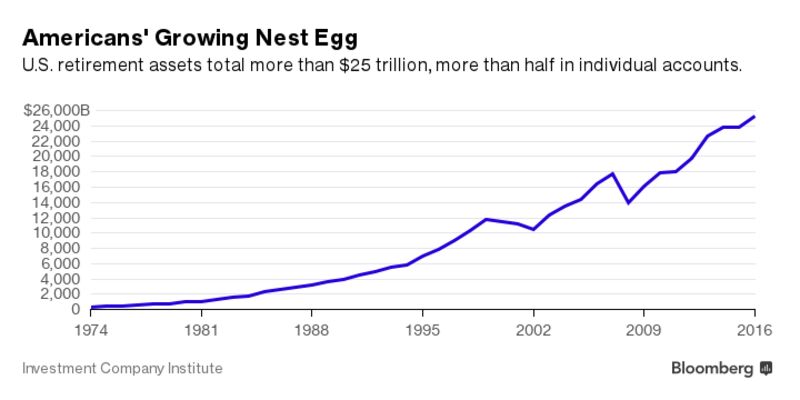
> On average and adjusting for inflation, retirees are entering their 80s richer than they were in their 60s and 70s.
This is a misleading interpretation of data. On average, yes, but at the median, no. The median retiree's net worth is less than $100k at 60 and continues to decline with age.
This is a really sloppy headline. "Cash" implies moving money out of stocks and into actual hard currency, which is not what they are talking about at all.
I found the tone of this article somewhat obnoxious. "Why aren't these old codgers getting out there and spending like they should? We gotta find ways to make them feel more comfortable!" As someone whose father is 75 and doesn't have a dime, because he didn't watch his spending or have a savings plan, I find this attitude rather disconcerting.
Haha, the owners of this economy are looking at the last, great reserve of consumer cash they can suck dry.
Labor has no pricing power. People working real jobs won't be spending wild dollars anytime soon. They've been neutered by wide-open valves of cheap imports.
Maybe there is need for a startup that can pool the retirement money from retirees and assure them of a comfortable life style till the time they die. I think this will allow the retirees to enjoy their life much more rather than worrying about "what might happen...".
I suspect the biggest reason this is happening is there's no healthcare in U.S. and retirees simply have to account for that. Who will help pay the hospital bills of the "educated spenders" with no money when they get a serious disease?


He built a house and bought a couple of nice cars living on about 100,000 a year. About 12 years ago he had a heart attack and stroke and was bed ridden. 12 years of doctor bills and hospice ate through almost every dollar he saved.
My grandmother sold the house and now lives on her social security. Maybe people 60 should not be so fast to go spend their cash. He was 72 when he got sick and 84 this year when he finally passed away. If something happens to our grandmother there wont be a nice $3 million to cover 12 years of hospitalizations and surgeries.