This is a misunderstanding of the American justice system at the most basic level. The burden is never on the defendant to prove their innocence. If the prosecution can’t prove that you stole it or knew it was stolen when you bought it, you aren’t guilty.
And most modern devices randomize MAC addresses ("Wi-Fi addresses" in Apple-ese, for probably obvious reasons) between networks, and even between broadcasts/connections to the same network.
In Linux changing the MAC address can be done simply on the command line, so I'd probably just write this functionality into a bash script that I'd call before ifup.
macOS rotates MAC addresses between networks by default, and between connections to the same network unless it's password-protected. (It's under System Settings -> "Details..." or three-dot menu by a network -> "Private Wi-Fi address.")
Windows also randomizes by default as long as your network controller supports it.
It sounds like Linux requires some textual configuration that depends on your distro.
Right. The overuse of "genuinely" most of all. Seems like they put Claude through a few good rounds of training to always answer questions about its consciousness, thoughts, etc., with something about how it's "genuinely unsure," and as a result, the model learned to use "genuinely" as an intensifier in all sorts of inappropriate contexts.
I tried it on my personal website, which I wrote without any AI whatsoever, and it decided it's "pure AI slop" based on "tricolon abuse" alone. I would be less mad if the examples it flagged were actually tricolons, but only a couple of them were! Most were lists with more than three things in them.
I tried it on my personal web site, which I don't think I've made any changes to in over 20 years except possibly removing some out of date links and it says it is pure AI slop.
The proof it cited was "Short Punch Fragments". These are:
• In a section where I say who I am I start with "Who am I? I'm Spider-Man!" and then on the next line say "OK, maybe not". Then there is a table showing my identities in various places.
"I'm Spider-Man!" and "OK, maybe not" are the evidence there that it is AI written.
• I've got a quiz on the page. It says someone is caught with all of the following items and asks what they were planning.
   1. A large needle and thread
   2. roll of paper
   3. Three small pebbles
   4. A small bag of fine-grained dust
   5. A small empty waterskin
   6. A pair of scissors
   7. A canteen full of cream
   8. A fur cap
   9. A purse full of counterfeit coins
  10. A raw egg
It cites lines 1, 3, and 8 of that as evidence of AI.
Only because so many of the articles posted on HN now are AI-written, and badly, too. A lot of tech people are so impressed with LLMs’ capabilities in code that they fail to recognize how bad they are at writing enjoyable prose. And it feels like a chore to write out a whole blog post by hand when the machine could do it for you! But the result we get is so, so much worse and more annoying.
I dislike AI prose too, the cadence of it really rubs me the wrong way, but, that said we've had a lot of great, informative articles lately, written with AI help, where you just have to grit your teeth and get through them to get the underlying knowledge.
I don't think that commenting on every article is going to make the posters suddenly decide to go back and rewrite it by hand. Some of them probably don't even speak English natively. The comments are getting more tiresome than the AI prose at this point.
Hopefully in a year or so the LLM output won't be so janky and obvious, so this might just be a phase everyone has to pull through.
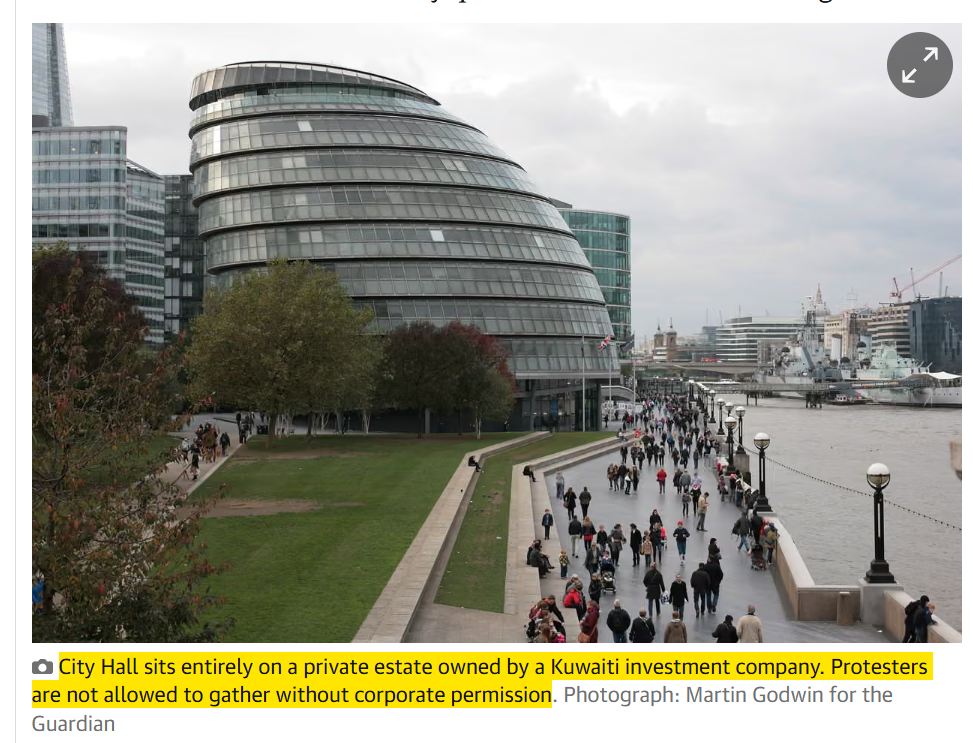
They apparently moved the location, but protesting at the new location is still heavily restricted [0] with a dystopian narrative.
> In order to achieve the balance between the rights of those holding a rally and the rights and freedoms of others to go about their business we have put together this guidance and simple application process.
Every single thing in the text you (inaccurately) quoted.
City Hall is no longer on a private estate, no Kuwaiti investment company is involved, and the application process involves no "corporate permission" - you submit a form to the city government, and it sounds like the point is to make sure each rally is allocated a separate area, and they don't deny permission outright.
> Every single thing in the text you (inaccurately) quoted.
Your first sentence makes no sense. It's quoted directly from the Guardian article, not from me.
> it sounds like the point is to make sure each rally is allocated a separate area, and they don't deny permission outright.
FWIW, look at the next article I linked. You're really understating the restrictions for a public, outdoor venue. This is on brand with restrictive public use.
- No noise directed outwards
- no noise after 6PM
- confined to two lawns (that can't fit more than 3k people)
- no sound speakers
- no overnight rallies even if quiet
- leave no trash
- no food for others
- you're strongly advised to fill out a notification form if your group is larger than a dozen people
> London’s seat of democratic governance now sits entirely on a private estate owned by a Kuwaiti investment outfit. John Biggs, the London Assembly member, tells me he has been prevented from doing television interviews outside the building by private security guards who insist he needs a special permit; protesters are not allowed to gather without corporate permission. “I think that as active citizens we’ve got a reasonable responsibility to test and push at these public/private borders,” he tells me. “It’s clear we’ve got the balance wrong at the moment.”
You “quoted”:
> City Hall sits entirely on a private estate owned by a Kuwaiti investment company. Protesters are not allowed to gather without corporate permission.
In both cases, it’s true. Higher taxes will drive some New Yorkers to Florida! That’s why the state government has to research the impact of a tax increase and set the brackets at a point where the amount they bring in, after subtracting lost revenue from people who move away, is maximized. A sensible tax increase won’t drive many New Yorkers to Florida, and it’ll make up for the few who do leave.
In this case, studios will need to do the same calculation with the cost to package and release server software / the income they’ll lose from going to a subscription model.
'Some' is a meaningless non-metric. Some people do anything.
Actual studies [1] show that the rich are not moving in response to wealth taxes, and in fact when they do move, it's almost never due to taxes.
> As we get more data on the post-pandemic period, we increase our knowledge of the major upheavals
that took place in New York between 2020 and 2022. Despite the state suffering a deep recession and massive out-migration during the pandemic, data show that New York’s tax base remains resilient. When taxes on millionaire earners were raised in 2021, tax revenue to the state increased by an estimated $3.6 billion and there was no detectable increase in high earner out-migration.
Do you eat at the cheapest restaurant every day?
Do you think that every Michelin Star restaurant immediately fails and shutters? Do you think everyone buys the $80 prepaid flip phones, and no one actually buys the $700+ iPhones?
Most people don't gravitate towards the cheapest option (in fact, many people find the cheapest option automatically suspect and won't buy it), but rather want a balance of affordable and desirable. No one living in NYC is doing it because they're gravitating towards the cheapest option in the first place, they're there because it has a high level of desirability comparative to its cost, even as expensive as it is.
Would it? Online services are not terminated. There's no SLA defined in the law:
> 60 days before a digital game operator ceases to provide services necessary for the ordinary use of the digital game, the operator shall communicate all of the following information to purchasers and prospective purchasers of the digital game:
> (i) The date on which services necessary for the ordinary use of the digital game will cease.
> (ii) Any services that will no longer be provided by the operator.
> (iii) Any game features that will no longer be available to the purchaser.
> (iv) Any known security risks that may result from the cessation of services.
> (v) How the purchaser can continue to use the digital game, or obtain a refund, pursuant to paragraph (2).
Scaling in the number of game servers isn't termination of service, though, and would not match the conditions laid out above.
But again, the players can use the service. The companies scaled back network resources, degrading the experience, but the service is still fundamentally available. Unless they put specific SLAs in the license agreement, the players are still receiving the online services that they advertised.


reply