Interesting issue on the UI lag. My 2022 4K Sony has no lag whatsoever.
Vision persistence with high intensity light is an interesting phenomenon. This is why people still love CRTs, too. OLEDs do not create that much of a light by themselves, so no persistence of vision is present.
Also, why an audible click is so bothering? I can't fathom that part, sorry. Nitpicking much? BTW, I'd rather have a proper relay in my devices rather than a high-power MOSFET which can short and has a shorter lifespan.
Your comment reminds me a couple of blog posts. One person wrote a 2500 word essay on something they hated so much. Then the thing got tuned or serviced or something, then they wrote 3000 word essay on how they love it. The kicker? The feature they hated most in the first was the feature they loved the most in the second one.
>Interesting issue on the UI lag. My 2022 4K Sony has no lag whatsoever.
Is it running Android TV?
>Also, why an audible click is so bothering? I can't fathom that part, sorry. Nitpicking much?
I would have expected a device that people put in their bedrooms to be silent. Or at least have an option in the settings to produce loud clicks at a different hour instead of 3am?
Yes, it's running Android TV. It also had some major updates along the way, and is still getting updates.
Personally I don't have such an expectation from my devices. Configurability would be nice, I agree, but no, I don't expect everything to be "solid state" in 2026.
RTings has done multi-year burn-in tests and OLED TVs have an exceptional lifespan before burn-in these days, I honestly don't know what motivates this particular concern any more. You'll probably have the caps fail before you notice anything, maybe even multiple rounds if you recap it.
I have looked to the same burn-in tests actually, and they were just starting doing it. Some of the screens got burn-in pretty quickly.
Yes, screens have improved vastly since the first days, but my life expectancy of these devices is much longer than a ordinary consumer. I don't change a TV every 5 years.
Yes, my duty cycle is much lower than the ones gone through testing, but having one less failure point for my screens is always better. Also, I'm not a nitpicky person about contrast numbers and whatnot. If I enjoy the thing I'm occasionally watching, I'm more than fine.
Having had OLEDs for a while now and never experiencing burn in even in my monitor I believe this issue is either very overblown by the small amount of bad experiences and requires a large amount of misuse before it becomes a problem.
I have seen burn-in personally in my couple of early OLED devices, and saw them pretty quickly, so when I was buying my only TV and seen that RTINGS tests, I decided on an LCD.
My OLED devices fared fine for a lot of years, but I'm not sold on OLED on large surfaces, and a good quality, dynamic backlit LCD is more than enough for my needs.
Two reasons: Wider viewing angles and light reflection rejection.
Not every TV is used by two people in a room devoid of lighting. Friends will come over, other things will be watched. Some people are very bothered when the ceiling lighting or sunlight from the window "alters" the image.
Enthusiasts are an interesting bunch. Some features loved by others are grave flaws for others. One can't make everyone happy, so matte screens are an acceptable compromise for it, AFAIK.
My old Bravia is matte-ish without "Viewing angle extending layer", which reduces contrast apparently. I'm happy with what I have. It shows moving images, syncs with sound, and is big enough.
> Not every TV is used by two people in a room devoid of lighting. Friends will come over, other things will be watched. Some people are very bothered when the ceiling lighting or sunlight from the window "alters" the image.
> Enthusiasts are an interesting bunch. Some features loved by others are grave flaws for others. One can't make everyone happy, so matte screens are an acceptable compromise for it, AFAIK.
You know what, fair enough. I don't mind these; but I do _hate_ the blurriness that the matte coatings introduce.
Now, I wouldn't call my wife a TV tech enthusiast, but I do know that she's bothered by the reflections occasionally when I don't mind, and I know with her eyesight she straight up physically cannot notice the extra blurriness that the coatings bring.
I have noticed that the darkest "black level" is less black (despite it being OLED screen) than on glossy screens in light conditions. That difference disappears in darker environment.
I’d now be actually curious to do a Pepsi-style challenge to test this on myself.
I give myself a ~low 40% chance of being able to tell within a minute when watching a TV show/movie _without subtitles_, maybe 60%ish with subtitles, and maybe low 80% if I was playing a game with any amount of text rendered on the screen.
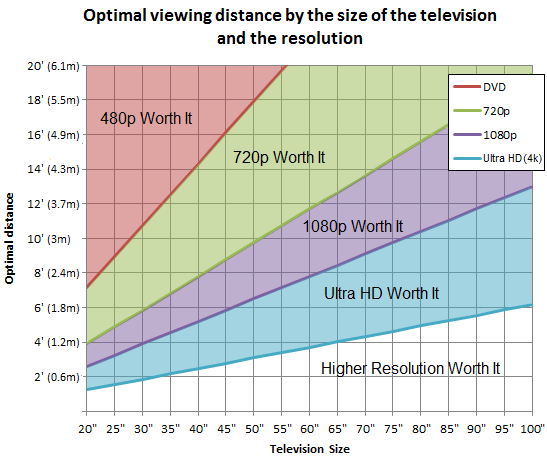
If you own a 50" 2160p ("4K") TV and are sitting more than 1.8m / 6ft away, you're already at the edge of being able to perceive any resolution increase over 1080p. For a 65" TV, its about 2.5m / 8ft.
So no, at typical viewing distance you are very unlikely to notice a sharpness decrease.
Tangentially related, but this is also why the 4K chase on this console generation is so stupid. The vast, vast majority of people will be viewing their TV way beyond the recommended viewing distance, and thus will only be resolving to 1080p with their eyes. We should be chasing better-looking effects and 120 FPS.
I’m at 65” and less than 2m away, and I absolutely can tell when text is not rendered at native resolution, which is why I’m also confident I’d be able to notice the matte coating too.
(I am also probably like three standard deviations _more annoyed_ by the blurriness than an average person, I’m more than willing to believe that an average person wouldn’t be able to tell, or at least wouldn’t be bothered by it anywhere close to the degree that I am.)
Well yeah, at that distance you are supposed to notice the difference in resolution, and presumably the difference between matte and glossy. Most living room situations aren't like that though.
More interesting than arguing a jumble of electrochemical reactions have taste? That may seem more readily familiar but is no less strange if you prod at it. Nonetheless it’s difficult to argue either don’t produce output that has qualities of discernment (ie taste).
The roulette pockets for the model are bigger for some outputs than others. Draw a big enough black box around it and a different one around humans and it's insistinguishable.
Isn't it just arguing that one complex weighted graph was tuned to output tokens that more align with what current day users would define as 'taste'?
I don't think it necessarily says anything about a model itself having 'taste' in some subjective way.
If the fashion changes would the model update with it without retraining? No. So the model doesn't have 'taste' in that sense. It has alignment to current human definitions of taste.
It is more capable of writing code I find tasteful and maintainable. It is debatable to what extent it itself has taste. Its outputs just suit my taste more than Codex's do, even though Codex introduces fewer bugs.
I'm a "Linux on Desktop" person, and the reason I use macOS on laptops is it's the best non-Linux OS which works great with Linux and comes with great hardware.
The funny thing is, I'm using macOS for ~20 years now, and there are "still" things which are way better on Linux. As a result, macOS is a laptop-only secondary OS for me.
I have a couple of Desktop computers both for work and personal use, and they run Linux exclusively, for 20+ years.
Not every house has GFCI, and old ones are not always retrofitted.
From top of my head, there are two main reasons:
1. C13/C14 is a bulky set of connectors, and fitting them to compact(er) things are not always easy. This also means cable needs additional care to keep somewhere else and label. Why label? See 2.
2. Not all appliances use the same amount of power. C13/C14 is an overkill for a small, non-grounded appliance. Use a figure 8 then, alright, but what happens when you mix your coffee grinder cable with your powerful hand blender's cable and use it at max power? Hot things. Not the soup, but burning cables.
In this age where we use aluminum cables because it's cheap, mixing low and high power appliances' cables will become a liability fast. Using unique connectors will make the reason to have detachable cables moot, and drive up the price.
Standardization? The awesome thing about standardization is, three are too many standards to choose from.
But the models are more intelligent than humans already and sentient beings, right? So they shall know the meanings innately. So, you don’t need to explain them what they mean.
You may give them better instructions, but they should already have the intellect to understand the assignment.
I know you're being facetious, but I think this is correct. The model might ask for clarification when given clearly borderline questions that tread the line between what is true, what is false, and even what is misleading. But there's the rub of someone being disingenious and saying "no explanation! Just answer!" It was a trap to begin with.
I don't think there is anything wrong with the results of this test.
It would be more interesting if we compared them to human results.
If you have trouble distinguishing between human and LLM results, that's interesting.
In Turkey, if my bank calls me, they also send a push notification telling "We are calling you. The representative's name is $NAME. You can talk safely".
People can be multi-dimensional. I’m a sysadmin/developer, yet I played in a symphony orchestra, and still play bass, take photos and read world classics, sci-fi and occasional philosophical books.
Why can’t he make music, read music history or biographies, or do other things?
Do all “software engineers” need to interface with a computer 7/24, Matrix style?
Of course you can, I think the author has taste, is clearly interested in design and I enjoyed looking through the images to see what I recognized. I should say that it obviously looks good, for the same reasons that movie sets look good and why we hire set designers/dressers.
It's also fair game to critique these photos from an artistic perspective. Some are clearly intentionally staged and I argue that the messaging is a little clumsy. Sure, it's hard to avoid if you've filled your space with expensive design objects. Another comparison is cooking blogs where the photographers add visual clutter that looks good on instagram, but is impractical and unrelated to the food being cooked. The space itself is very nice, though you've got to be absolutely anal about keeping clutter down.


Vision persistence with high intensity light is an interesting phenomenon. This is why people still love CRTs, too. OLEDs do not create that much of a light by themselves, so no persistence of vision is present.
Also, why an audible click is so bothering? I can't fathom that part, sorry. Nitpicking much? BTW, I'd rather have a proper relay in my devices rather than a high-power MOSFET which can short and has a shorter lifespan.
Your comment reminds me a couple of blog posts. One person wrote a 2500 word essay on something they hated so much. Then the thing got tuned or serviced or something, then they wrote 3000 word essay on how they love it. The kicker? The feature they hated most in the first was the feature they loved the most in the second one.
reply