It's interesting that saying the Earth is more than 10,000 years old is not haram in Saudi Arabia. I thought it would be, since they are so religious, but it turns out the Koran doesn't make any claims about the age of the Earth, so you are free to say that the Earth is billions of years old and not be accused of blasphemy.
I mean, even in countries with extremely high levels of Christianity, such as Romania, you won't be accused of blasphemy for just... agreeing with science. Both Christianity and Islam are pretty similar after all, so hopefully that is not too surprising.
I can't think of a country where you even might be accused of blasphemy, though I'll admit I am not very familiar with the topic.
The UPI payment system in India seems to work really well. I'm not sure about the architecture exactly, but there seems to be a way to generate one-time passwords that you can use to pay people a fixed amount. E.g. you go to a website or store, and they display a QR code for payment, which contains the payment recipient information and amount of the charge. When you scan it, you are taken to your bank app where you authorize the recipeint and the amount, then you are given a special code in the form of a QR code or alphanumeric code. The person recieving the payment can scan the code to recieve payment ... or if you are online you can paste the alphanumeric code. No other information is exchanged. There's nothing that can compromise your ID or account info.
Pretty amazing!
Insane that a developing country has something so seemless, and meanwhile in the USA my credit card number is stolen online every 3 to 5 years, necessitating cancellations and in some cases (as with Chase) I had to close the entire account as they could not stop the fraud even after issuing 5 new cards over the space of 6 months--somehow the new card authorizations were being ported automatically into some subscription systems.
How much of this action by Bambu is driven by the fact that they're being threatened from Washington DC that they will have to be able to prevent people from printing "illegal" items, like gun parts, in the future?
Oh lord. If this is the trend, I probably can't avoid improving my Rust language knowledge in the long term. I hate reading Rust so much right now. I guess I just have to get over that hump.
Learning Rust is more alike to learning a new programming paradigm (e.g. functional when you only know imperative) than a new language with different syntax only. If you ignore that and try to jump directly to writing code more or less the same way as you used to, it will be painful. So take it slow and follow along with The Book (https://doc.rust-lang.org/book/). It all makes sense eventually and is very much worth it!
Was interesting to read this post because I've always been an extrovert and have never had trouble making friends. I usually make friends quickly ... and my problem is in the other direction ... I have too many friends and people get mad at me because I don't have the time to keep up with every relationship I've built in 40+ years.
I've been a best man 6 times. A groomsman 20+ times. I'm spread really thin now that I also have kids and a wife and family commitments.
Sometimes I actually crave solitude more than anything else.
Reading this post is almost like reading about another tribe from a distant place, and what it feels like to live their lives.
Is it weird that I'm kind of envious of this guy and his life? Not enough to trade places ... because I'd miss my wife and kids and close friends ... but if I could just like be him for a few weeks and then come back to my life.
My biggest gripe with Rust, which certainly reflects my own shortcomings, is that when I go back and revisit simple Rust programs I wrote more than a year ago, it takes me a long time to understand what I was even doing in a particular part of the program. This is my weakness ... I'm not great with Rust and I don't use it enough to get better. But it is what it is.
In contrast, when I go back and read Go or C code I wrote years ago, I have no trouble at all quickly figuring out what I was doing in the small programs I write.
The way these issues manifest themselves, as it recently did, was I went back to add a simple addition to a CLI tool I wrote for myself a year ago, and I was having trouble doing it because I couldn't quickly understand what I had been doing a year ago ... so I just had an AI agent do it for me. This was the kind of change that if it was a Go program, I would've done manually myself in about 5 or 10 mins.
Somewhat related. My mom once yelled at me for losing a necklace she really liked. Then we were moving her stuff out of her house and found the necklace behind a wardrobe, wedged between it and the wall. It had been there for like 40 years, layered in dust.
On 9 July 1537, Martin Luther wrote in a letter to Wolfgang Capito about a lost golden ring: "Pro annulo aureo gratias tibi agit mea Catharina, quam vix unquam magis indignatam vidi, quam ubi sensit, cum vel furto sublatum, vel sua negligentia (quod nec mihi verisimile est, licet usque ingerenti) amissum, quod persuaseram ei, hoc donum esse felix omen et augurium ei missum, tanquam nunc certum esset, vestram Ecclesiam cum nostra suaviter concordare; id mire dolet mulieri."[1]
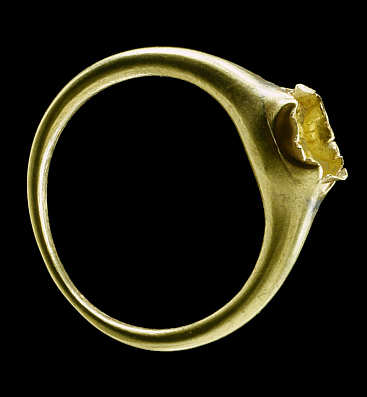
When Luther's house in Wittenberg was excavated about 20 years ago, a golden ring[2] was found that must have been deposited there before 1540. It is therefore quite likely that this is the ring mentioned by Luther in 1537.
My Catherine thanks you for the golden ring, whom I have hardly ever seen more indignant than when she realized that it had been stolen or lost through her own negligence (which is not likely for me, although I still insist on it), which I had persuaded her that this gift was a happy omen and augury sent to her, as if it were now certain that your Church would agree pleasantly with ours; this grieves the woman wonderfully.
My mom once was getting ready for work and I hear a pop and hear my mom yelling. I go in and her necklace fell off the dresser; a "dust buster" wall wart was plugged in back there and it fell across the prongs, shorting it out.
The ground pin, when "up", is higher than the hot, so in certain situations it can prevent something from shorting the hot and neutral. Code (?) or convention requires it if you have a metal faceplate, and hospitals require it. People generally like them mounted ground down because then they look like little faces. :-)
Wouldn't it short hot and ground then, and still turn the necklace into a short-lived fuse?
The more practical reason to mount ground down is that wall warts with ground pins or polarized prongs nearly universally arrange them so that they're hanging down when inserted into a ground-down plug. If the plug's flipped, the wall wart's upside down and its weight is trying to lever it out of the wall.
Yes, in that case it would short hot and ground, which is effectively the same and hot and neutral, since at the main panel hot and ground are bounded together. But if it were, say, a metal credit card or something rigid, it might just fall on the ground, or could hit the ground and neutral.
Law enforcement being lazy, dumb, and incompetent is not an unpredictable bug. Its predictable. The smartest human capital does not go into law enforcement in this country. They go to other industries. Flock needs to have procedures for whitelisting plates when errors are discovered because these kinds of issues are very common.


reply