Wow, I can't believe the "free market" argument is being used to justify top military leaders serving other countries. I guess we aren't a country anymore. Just one big (free) market.
Sounds like your friends are simply unmotivated to voluntarily work for a system they believe is corrupt.
Laziness has always been a capitalist codeword for "noncompliant worker."
Also, you have to look at the bigger picture here. We can't just put our blinders on and ignore the conditions of this natural UBI experiment, as you are putting it. There was no sense that with this UBI--it wasn't--they were going to be productive members of some socialist society. No, it was a moment where people felt like it was their turn to exploit a system that has been exploiting them since they were children.
I agree with the sentiment that in this context, under the current conditions created by corporate capitalism, UBI would be a horrible idea. It would be better for the people in the long run if they --we--we're out in the streets than packed away in some small rat hole of an apartment, suckling on the corporate dole.
If that's your position, then people will begin resorting to violence. Your property is only secured by force. Put the people in desperate situations and they will no longer play by the rules which put them at an extreme disadvantage.
This is the lesson every corrupt nation learns the hard way. We agree to the laws of the nation to secure peace, but when that peace becomes oppressive, when that peace means slavery to the oligarchy, that peace is no longer peace but silent war.
The people will not tolerate this extreme inequality anymore.
Edit: to those claiming what I've said is "hateful" or incendiary...this is simply the truth -- as proven by history. Don't shoot the messenger.
To anyone following this comment thread, this is exactly where the belief “others should be compelled to give me resources” leads. Thanks for illustrating where your hateful ideology ends up.
The person you're responding to can perform a similar dismissal of your comment. The only thing that you have illustrated is that it's easy to create straw men for each other to feel smug about, when you have no goal of understanding or finding common ground. Pushing an obtuse overly-simplistic narrative merely attracts others to respond in kind. No wonder we're headed towards civil war.
IMO the underlying don't-fight-your-fellow-citizen analysis here is that the debt treadmill has to bind up some time. Housing rent is at the first level, followed by mortgages, then muni bonds, wall st paper games, etc. All these levels of recurring payments that have been created to channel real wealth upwards and force everybody to keep working in spite of technological abundance. If it does not bind up now, that's just delaying the inevitable to some time in the future when the phony asset valuations have gotten higher and even less serviceable.
You: The government messed it up. The government needs to fix it.
Government: Absolutely! We too would also like to become a larger socialist entity that puts everyone on the dole. We will fix it all for you! Just give us complete control!
Landlords probably should have considered this possibility when making their investment in rental property. They wouldn't be in this position had they left that home on the market for an actual resident to buy.
You don’t want to live in a society that is forever at risk of forced government closures. It drives up risk which drives up the necessary return for an investment to be worth it which makes starting new ventures prohibitively difficult. It makes thinking long-term impossible because you can’t risk hiring full time employees.
Here in California, my rock climbing gym, which has to pay sky-high rent, was closed down when we locked down 6+ months ago. When gyms were allowed to reopen they weren’t classified as a gym and somehow were never allowed to reopen. Now gyms are closed again anyway (thanks Newsom). It’s been like 7 months of them being completely closed while paying sky-high rent. They weren’t swimming in money before all this; rock climbing is a niche market. What was done to them is WRONG.
The government is broke. They will just have to take on more debt to make the proposed business "reparations." I think it's all gone. There's nothing that can fix what has happened to this nation... from the criminal monetary policies to this situation...America is gone.
"Fascism," "democracy," what's the difference? There's always an elite class pulling the strings. The world has always been a mess. The only thing that is dying is our illusions.
Edit: for those that downvote me, go tell the millions living in violent poverty how magical democracy is. There will always be a show. What matters is who's putting on the show.
If that was the case, then why aren't our schools teaching white supremacy and nationalism? Isn't the opposite the case?
Also, what's wrong with nationalism? Isn't it better to have nations who are interested in the well being of their people as opposed to a world controlled by globalist corporations?
It seems to me like the people have been conditioned against nationalism and towards globalism which favors corporate control.
Ultimately, individuals are responsible for their choices in "free societies." I don't want to live in a world where all information is regulated by the government.
This is a good story about poor choices made by an individual, but I hope it is not fodder for any attempt at regulating what free people choose to do with their lives. I think we need to do a better job at educating people on the dangers of freedom...what do you guys think? Perhaps we need some sort of "media literacy" education at the primary school level that trains people in evaluating sources of information ( which seems to be reserved for the university level in many cases, unfortunately ).
My thoughts are with the family of this man.
Edit: Wow, I'm surprised at the negative response to my comment. What is so controversial about my views here?
I don't think there is any argument at regulating what free people do. The argument here at best is for good, proven information to be available as well as eradicating quack therapies based on false claims that don't work because they unfortunately put people (like this man) at risk.
This is not an argument for regulating information, you are still free to peddle quack as long as you don't make false or unproven claims, and if you are sure your "quack" is actually legitimate you are free to do research, studies and tests just like the supposedly-evil "big pharma".
> I believe going to a doctor is the way of accessing "proven information."
Either that or government-approved websites (like the NHS is providing in the UK). It is in the government's best interest to keep you alive for as long as possible (if nothing else, just so you can pay tax longer), and while they aren't always perfect (like the current covid-19 response from some countries) I would still trust them more than some random people playing doctors on social media.
> What would the mechanism for "eradicating" these "quack therapies" look like?
Outlawing unproven medical claims, and actually enforce the law?
> Well, can we really say big pharma isn't evil to some degree
Perfection will never be achieved, but if we take all the effects of "big pharma" (both good and bad, across all diseases) and compare it to the effects of backyard quack medicine, who wins? I'm willing to bet good money that big pharma wins by a large margin, so I'd be willing to trust them until there is enough evidence that says otherwise.
>Outlawing unproven medical claims, and actually enforce the law?
This is extremely dangerous. The complexity of human biology and our ethical standards don't intersect in a way for any treatment to be 'proven'. There is just statistical evidence of efficacy for some subset of humans who's condition is materially in the same vicinity of any given patient. However, any given patient has zero control over what testing has been done on any given intervention, and therefore may have a perfectly viable treatment left legally outside of their reach because we just haven't got to test their case yet (and may never).
> Outlawing unproven medical claims, and actually enforce the law?
Would faith based approaches fall under your definition of "unproven medical claims?"
I get what you are saying, but if someone wants to take their chances on some "quackery," shouldn't it be their right to do so? Obviously this individual knew that he was engaging in alternative medicine that is not recognized by the mainstream.
I don't believe in this particular alternative medicine, but I don't believe established science understands everything in this world and believe individuals should retain the right to explore alternative perspectives.
> Would faith based approaches fall under your definition of "unproven medical claims?"
Yes, I don't see why it shouldn't.
> I get what you are saying, but if someone wants to take their chances on some "quackery," shouldn't it be their right to do so?
The problem is that quackery being around puts people at risk like this man. This man didn't outright decide to do quack, he decided based on unproven claims made by the quack peddlers that this alternative treatment would somehow work and be better than the conventional, modern medicine.
Furthermore during his alternative "therapy" he not only did it for himself but attracted a large following online, claiming that this treatment was working and thus encouraging other people to go down the same path.
> I don't believe established science understands everything in this world and believe individuals should retain the right to explore alternative perspectives.
Established science has never claimed to understand everything. Established science adjusts its understanding of the world based on evidence and is constantly doing new research to further that understanding. I find it very unlikely that someone playing doctor on social media would do better than a multibillion-dollar industry.
When journalism is paid for primarily by corporate sponsors, the premise of "objective journalism" is absurd. People have to pay for their news if they wish to have the slightest hope of it being objective, but with the ubiquity of free content, paying for journalism now seems like an unwelcome deviation from the norm in the eyes of many. Ad sponsored journalism, and media in general, has poisoned the well. When you are used to getting something for free, it feels wrong when you have to pay for it. This cripples alternative media that isn't reliant on corporate sponsors...thus the ecosystem for "objective journalism" is weak.
The current environment, with respect to the aforementioned incentives, makes objectivity difficult -- not to mention the political/economic instability which adds tons of fuel on this fire.
I sometimes wonder what the authors of the U.S. constitution would think about the modern "press". I wonder whether in some alternate universe the constitution could have been interpreted in such a way that special protections for the "press" only apply to the LITERAL press, i.e., to those who physically print news onto paper with a printing press. The world could be a lot different today if that's how our interpretation of the constitution had turned out (such a world would be better in some ways, maybe worse in others).
A physical newspaper has a natural tendency to incentivize payment models where the reader pays for the paper; a physical newspaper is much harder to alter after-the-fact; and a physical newspaper lends itself to a daily news cycle which gives writers time to think more carefully about what they write (with "Extra" editions being reserved for truly rare occasions like war breaking out or presidential assassinations).
I suppose we would have to reason about the intention/function of the press. As far as I understand, freedom of the press was about the dissemination of ideas. In a democratic republic, the people must have a means of circulating information about various issues so that voters can cast informed votes.
It could be argued that the modern press spreads confusion and is less about the dissemination of ideas for the purpose of informing the voting public; however, the history of the press is not a glorious one. The press has always been a mess.
Nonetheless, I think, as you say, the "slow press" is more in line with the idea of informing the public. The "continuous press" is more about pushing propaganda and conditioning the public...in my view.
The constitution doesn't have any special protections for the "press".
Generally, the courts have fairly consistently held that there is no constitutional differentiation between journalists and non-journalists in protection of free speech.
Special privileges and rights for the press are granted by means other than the constitution.
Gosh, thanks. I never cease to be amazed at my own ignorance. So I guess that makes all the rhetoric about "the fourth branch of government" even sillier than I already thought it was. (If journalism were to be a fourth branch, then it ought to have some "checks and balances", but right now it seems to have about as many "checks and balances" as Xerxes the God-King of Persia...)
Well of course it lacks checks and balances - it doesn't have any legislative power. To pretend otherwise is to conflate state power with personal rights. States don't have rights.
Children have become more of a burden than a benefit in many ways. We once had much use for our children. When people were more independent and everyone pretty much had a small business, children were seen as the life blood of that business. Now, we are pretty much expected to fill a role at some large corporation -- which Japan is the greatest example of. Also, the family centered culture has changed to a work centered culture. It used to be a mark of shame not to have a large family -- you were seen as a "dead end."
I don't think these changes are natural, given how little control people have over their lives. This stuff is being pushed from the top.
I started to read this waiting for the punchline to a Dad joke. Kids can still mow lawns for sure.
>This stuff is being pushed from the top.
Is this some kind of Sparta thing? Like you all go up to the top of the mountain and someone pushes Dad off? Because if you actually mean there's a "top" that is dictating human sexuality I am deeply, deeply interested in seeing a schematic diagram for how that system works.
>It used to be a mark of shame not to have a large family
When and where was this? As someone who grew up Catholic it feels like that cut both ways.
To be vaguely serious for longer than I want, my wife and I just had a long, unfun conversation about how hard it is to deal with her mom's dementia and I don't know that we could do anywhere near as well with dealing with it if we didn't have a kid of our own. It's a shitty Ponzi schema, but the alternative is being Shakers.
Old calculus: "I need to have lots of children so they support me in my old age. No matter the cost."
New calculus: "Between retirement accounts and welfare, society will support me in my old age. Children are really, really expensive."
It's economics, plain and simple. Of course there's a "top" and the "top" does dictate the structure. If you doubt that, ask: what percent of your income do you pay in taxes, and what percent of his income does your CEO pay in taxes (assuming you work at a typical bigcorp)?
I'm not saying that "yolo all the way to carrying capacity -- and beyond!" would be a better policy, but it clearly used to be the policy and isn't anymore. Personally, I think we dodged a big bullet and took a little one. The "little" bullet is still going to hurt quite a bit, though.
This, but also people used to see having a family as being the meaning of their lives. In the modern world, the alternative meaning of life invention is the Career™. This alone, that people have been influenced to believe a career is a replacement for having a family, is highly suspect of "top-down" influence. We don't even have the perspective of how ridiculous career driven culture is.
This also causes people to move farther away from their families for both school and then work, often meaning that the grandparent support system is not available when you want to have kids.
That, in my opinion, is taken for granted more than anything else.
It also causes people to wait longer and longer to have children. My twins, my first children, came when I was 38 years old. My wife was 35. Most of our friends and family were also well into their 30s before having their first kid. This is not a winning strategy...
I think there's definitely something to this, and I'd agree that career driven culture is very toxic.
But I'd also hesitate to call it "top-down" influence. That would drastically downplay the autonomy we have in first-world countries. Nobody is forced to prioritize their career over everything else. In most countries, I'd say it's the complete opposite - tax incentives and benefits are usually structured to encourage child-rearing.
It's too easy for everyone to blame "the man" or "society" for a mindset that is entirely self-inflicted - with the exception of the US system tying healthcare to employment. That is definitely a top-down influence.
> It's too easy for everyone to blame "the man" or "society" for a mindset that is entirely self-inflicted - with the exception of the US system tying healthcare to employment. That is definitely a top-down influence.
The truth is that most "toxic culture" issues are systemic, so dumping blame on individuals for following systemic incentives doesn't make any sense.
Nobody is forced to prioritize their career, but a lot of people don't exactly have a choice to pursue leisure either. Lot's of people working paycheck to paycheck with no savings. How can you start a family in this country under those conditions?
> The truth is that most "toxic culture" issues are systemic, so dumping blame on individuals for following systemic incentives doesn't make any sense.
Aside from tying healthcare to employment in the USA, what systemic issues are there?
> Nobody is forced to prioritize their career, but a lot of people don't exactly have a choice to pursue leisure either. Lot's of people working paycheck to paycheck with no savings. How can you start a family in this country under those conditions?
Yet birthrates decrease with income - lower income households have higher birthrates [0]. This suggests that a lower fertility rate is indeed a choice, rather than economic necessity.
top down to me equal some secret cabal of people that push an agenda
systemic to me means the way the system is but how the system got that way would be the random inputs of thousands or even millions of individual and uncoordinated actions.
People living paycheck to paycheck seems like it's always been a thing even when they had larger families. In fact the largest families in the modern world come from the people with the least amount of money (not judging, just stating what I've read). So having a paycheck looks like it has the opposite effect of encouraging family. No I'm not arguing that we should therefore get less pay. Just arguing against that idea that if everyone had a paycheck large enough to support a bigger family that they'd start having bigger families.
I would agree that not all systemic problems are top down, but many are, and there are "secret cabals" dedicated to creating and propagating such systems. It doesn't make sense to me to define systemic problems as strictly random, since humans attempt to create top-down, complex systems constantly (especially post-WW2 in more modern society).
> People living paycheck to paycheck seems like it's always been a thing even when they had larger families.
Different eras, different issues. In agrarian times a large family was an investment in future labor, and as a retirement/continuity strategy. In modern society, adding children is a significant expense, and with the easy availability of birth control, it's far more of a choice. In both cases, people were following the rational incentives that society has created for them.
We can argue about whether the current economic circumstances are random or top-down, but in either case, if you change the incentives for having kids (universal healthcare, affordable childcare, food/housing security, etc.) then you will get more kids.
Society can only support you in old age if there are enough younger people around. Unfortunately, even though kids are needed for society to function and keep going, not much of the cost of raising kids is socialized, at least in the states. Day care for one kid where I live is $1700/month and rising, you have to be rich to afford it.
It's important to note that in Germany, at least, day care is provided by the state at no cost, starting from the age of 3mo or so. You also get 300 euros a month per child. German society has made a concerted effort to encourage that people have children in Germany. It's an idea worth copying, IMHO.
"Society can only support you in old age if there are enough younger people around."
I do not agree with that. In my opinion, technology advancements (say, driverless cars) will make reduce the amount of young people needed to support for older people.
I have yet to see any technology that will change a bedpan in the next 30 years. Much less provide the most important component to an older person’s mental (and hence in some ways physical) health - which is the company of other humans, family and friends, and typically grand children and other decendants.
I don't think loneliness will be massive issue. Considering the population of young adults and adults already suffering from it. Nothing will be different for us. And the communications are likely to improve so this is one thing that technology can solve.
In that case, if these technologies become so successful to eliminate the need for young people, they will basically become our successor species and all this is moot anyways.
Obviously that won’t happen overnight, but it could definitely happen gradually.
If declining birth rate is a matter of what people can afford, we should look for some sort of correlation between wealth and birth rate.
To the best of my knowledge, the correlation is somewhat negative--that is, rich people have lower average birth rates than poor people.
How can it be economics "plain and simple" if even people who can easily afford to raise large families choose not to? Mark Zuckerberg and Priscilla Chan could afford more kids than the Duggars. But they have two.
For the same reason that the CEO of the fortune-500 I work at ran around with a broken phone screen for the better part of a year: things cost time and energy, not just money. Children even moreso. Being cash-rich doesn't make you rich in time and energy.
> New calculus: "Between retirement accounts and welfare, society will support me in my old age. Children are really, really expensive."
My calculus is not at all that society will support me. In fact, it’s the opposite. I anticipate no support from society, but I also don’t want to burden my family or society so I hope to be able to go out on my own terms once I am no longer self sufficient.
Some people have extraordinary wealth and they have the ability to set economic incentives, policies, and cultural influences for certain types of behavior to emerge. There's a hierarchy to our societies, there are people with great power and people with little to no power. I guess the greatest magic trick of the modern world is to make people believe such things do not exist.
IMO a greater magic trick is convincing folks like you that these rich people are actually powerful enough to control fundamental behaviors like sex and reproduction.
It's a profoundly dis-empowering and anti-democratic message, which is of course why a lot of those rich people are happy for you to believe it.
The reality is this: in every instance we know of, making education and birth control available to women (not forcing, just giving them the option) has resulted in declining birth rates and increasing standards of living.
It's really quite inconvenient to be pregnant, to parent a newborn, and to be responsible for a child for 2+ decades. It's very rewarding, but it's also really hard. You don't need a global conspiracy to explain why many women limit or opt against it if given the chance.
Parenting is hard and expensive, especially these days in the developed world where people have children late and most people don’t live near extended family. My parents moving near me totally changed my wife and my outlook on having a third (from “no way, too sleepy” to “hey remember when the little one was just a baby?”)
Money is just one form of wealth. Having a network of trusted, productive people, such as healthy grandparents who can assist with raising children is another.
I can see in my extended family and friends the monetary and general success of those with supportive families (especially those families with multiple brothers) that worked together versus those families that were split apart and did not have someone to rely on. They are in completely different socioeconomic classes now.
Are you saying there are no mechanisms that allow wealthy people to influence human behavior on a large scale? Please read "Propaganda" by Edward Bernays.
France has tried. They even give subsidies. But the fertility rate is only 1.85.
The groups that are still growing are those that oppress women. Islamic countries [1] and ultra-orthodox Jews, especially. Evangelical Christians used to be higher but have now dropped down to the below-replacement US rate.
Teen pregnancies are way down in the US. So are abortions; that's not it.
Nobody really understands why. There's lots of speculation. The decline of religion? Better birth control? Video games? Declining testosterone levels? Fewer people in agriculture?
What good are books if we can't direct people at them? That book makes my case. The fact that Bernays was a major advisor for the media complex of America makes the book an even more significant piece of evidence for my position.
Ok...the main point is that there is a shadow government that shapes our culture and people's perceptions through mass media and by corrupting influential people for the purpose of endorsing certain ideas/products. In that work, Bernays details these types of "shadow governments."
It's funny how people dismiss things so readily by labeling them "conspiracy theory." I just can't imagine looking at a world with such great wealth inequality and coming to the conclusion that this is an equal playing field where everyone exerts the same influence on the evolution of humanity.
Social progress influences choice, which in turn influences economies, which influence people.
There is no cabal of They. The "shadow government" thesis is straight-up conspiracy batshit.
Unless you mean the Standing Committee of the National People's Congress of the People's Republic of China who certainly authorized the two-child law just a few years back, but they're not really a shadow government. They're a regular one, just not very transparent.
Ultimately both Chinese communism (via Hegel) and Western feminism (via Wollstonecraft) trace their origins back to the French Revolution, so maybe you are being controlled by Robespierre.
>Because if you actually mean there's a "top" that is dictating human sexuality I am deeply, deeply interested in seeing a schematic diagram for how that system works.
First, a top dictating human sexuality is hilarious to read out of context. Also somewhat accurate.
Anyway, I don't think they mean there is a concrete system designed to keep people from reproducing. It's more of a feedback loop where the richest people in the world get concerned about things like global warming, overpopulation, and whatever else risks their way of life and so they use their social capital to dictate ideas and ideals that protect them. They can do this with things like think tanks or social media influencers or whatever. It's not some highly organized psyop but it's effective because they have so much economic influence.
I think you're trying to very generously interpret a conspiracy theory that doesn't stand up to a moment's scrutiny. Access to contraception, and a rise in women's education and employment, are not a message imposed on society by the wealthy, inadvertently or otherwise, nor have they occurred on the timeline of concerns such as climate change and resource exhaustion. They are social consequences of the Enlightenment.
Consider how attitudes towards contraception have changed over time. There was a time, not that long ago, where the separation of procreation from the procreative act was considered harmful to both society and the individual.
There is a cultural elite, who’s effect has been so profound, they have led you to believe that such a cultural norm as we enjoy today was inevitable and have convinced the world that taking a perfectly healthy reproductive system and making it dysfunctional is “healthcare”.
That was people disliking the change and being loud. And they failed to pose their will on those who found contraception useful for their own lives.
And they failed also because non stigmatized contraception lowers teenage pregnancies and make aids spread less. Meaning it actually solves societal problems.
Inability to control pregnancy means less heath, particularly for women and small children.
There is no cultural elite brainwashing me into believe otherwise. I can arrive at this position all on my lonesome, simply by rejecting the appalling prejudices of the Catholic church (and many other religions), misogynists in general, and bigoted authoritarians (but I repeat myself); both on the basis of the crushing harm they have inflicted over the centuries, and the colossal waste of talent due to the systematic oppression of women.
As for this:
> the separation of procreation from the procreative act was considered harmful to both society and the individual
That depends who you read. If your selectively chosen history of the last 6,000 years consists entirely of texts written by and/or documenting the fun police, I can see how you might arrive at this conclusion. On the other hand, there have always been voices otherwise. Until the Enlightenment they tended to be pilloried and/or executed, but that doesn't exactly highlight the hypocrisy in charge as something to be desired, rather something to be abandoned.
edit: poking around, this seems to be some reference to an American college commencement speech. I'm not an American, so I didn't get the cultural allusion, sorry.
Point of fact, I don't swim in your water at all. Any assumptions you may choose to make about the cultural perspective, skin colour, second language, religious tradition(s), countr(ies) of birth/residence/affiliation/upbringing, nationality of parents and/or in-laws, immigration status, education, newspaper subscriptions, food and musical preferences, or political leanings influencing my worldview are likely flat wrong.
Contraception is not dysfunction, and this is neither a parochial, nor (what-americans-call-"liberal") liberal assertion.
> if you actually mean there's a "top" that is dictating human sexuality I am deeply, deeply interested in seeing a schematic diagram for how that system works.
Access to birth control and abortion, social services and welfare, trends in divorce and family court ... All of these things are top-down forces that create a tapestry heavily influencing human sexuality and the choices men and women make. One only has to look at how different things were 50 or so (or less) years ago before these things were as widespread.
Premodern society where women were effectively property, where religion dictated their role, where marriage and a woman staying at home were the social norm. You're trying to pretend like social policy is a new thing when the Catholic Church has been controlling the rights of individuals for a very long time. To such an extent that Kings were generally subservient to the Pope. And then those Kings and Queens did actions like the Inquisition where they forced individuals to either convert to Catholicism, be exiled, or be murdered.
History goes through many stages of social belief intertwined with social control. In ancient Rome there was a plant that caused abortions and was so popular it went extinct [1]. However also in ancient Rome, Augustus patronized writers like Virgil to help instil "traditional family values" in the Roman population.
“Premodern?” The US fertility rate fell from 3.65 in 1960 to below replacement in 1972. In that time, the labor force participation rate of married women went from 32% to 42%. Then it’s been pretty stable since then between 1.8-2.1, even as the labor force participation rate for married women went from 42% to 67%. We are talking about much more recent social trends at issue.
Perhaps the "premodern societies" that are emphasized in educational settings had those qualities. Maybe that says more about our educational values than about premodern societies. Many ancient people didn't emphasize property in the first place. Many others were more matriarchal than patriarchal. Sure, Catholicism was fairly irredeemable...
I did my time in the Catholic church. There were some weird moments, but I got a lot luckier than a lot of other kids (and women, indigenous, etc.) Now I get to say my truth. Actually, anyone who reads history can say it too.
While I don't really believe in a 'conspiracy' - I can easily see "targeted 'top down' forces" in the reverse direction...Limiting women's access birth control, abortion, etc. Hell - just getting your tubes tied can be 10x harder then getting a vasectomy.
If societal forces can be so effective in limiting women's choices/options, is hard to believe they could have had a hand in expanding them as well?
I have a 2 year old. It was an accident as both I and my wife didn’t want children or weren’t ready. I’ve got to say that it has become the best part of my life and yes it is not easy when you’re looking in from the outside but becoming a parent changes you, you become more resilient, objevtives in life change, etc So, no, children are not a burden unless you make it to be.
It’s wonderful that it’s worked out for you, but I can show you to Facebook support groups of thousands of parents that abhor and regret having children. Children by their very nature are a burden because they can’t care for themselves.
Are we arguing with the very data from this article? Clearly children are not that in demand if the fertility rate is experiencing a “jaw dropping global crash”.
children have been a cornerstone of human life from the start, but you think the outliers on facebook are the norm?
everything the commenter described are not things one would “demand” before having children, but would only experience after having them. honestly, referring to having children as something that would be “in demand” is disgusting to me
Yes, children "in demand" sounds like they are some kind of marketable product, it does sound a bit misguided.
But I don't blame people who don't want to have children, when we are pressured to produce and be as productive as possible, to be the best versions of ourselves, to be always strive to have more and be ever more end always self improve, the place of parenting in one's life has diminished quite a bit. I am glad I did become a parent and in a way I am out of that rat race as my perspective, my goals, my wants, everything has changed and I think for the better.
America has had tons of immigrants working 24/7 to run a restaurant, a laundry shop, or a drugstore, while putting their kids through school. Most of them weren't forced to come to America or choose such a job: they did it because even maintaining a 24-hour convenience store is less grueling work than planting rice, and they're rejecting their children's "help" because they want their children to study and have even better, more comfortable jobs.
Pre-modern agricultural societies had huge families because there was so much work that you could always use an extra pair of hands. (Also, many of them died off anyway so you had to factor that in.) You are looking at the past with a seriously rose-tinted lens.
Child mortality was huge, fixing that definitely provided a reason to put a break to the child bearing machine. There are still poor parts of the world where that is still the norm but it’s dwindling fast
It also just costs more to do basic things. Buying a house, finding an apartment, college, finding a job (more competitive), there’s trends of more loneliness and lack of community, you have to learn graphql now, it doesn’t end, and so by the time you find yourself stable in all these things you’re much older, and well, worn out.
Starting a family used to be the first thing you did, but now it’s more of the capstone that one could easily not burden themselves with after all of life’s bullshit.
We are psychologically and financially exhausting a generation.
Also not sure why you are downvoted. As a 33 year old working professional who jumped through life's bullshit tip finally start a family, this resonates.
Because the truth is painful. People don't want to believe things are bad. People will fight tooth and nail to hold onto their perception that we are living in some sort of utopia and that everything is sunshine and rainbows.
I don't blame people that want to look the other way...it's not a pleasant sight.
It's sure ain't easy but if you take a look at the history of mankind it sure is paradise. War and famine have has been the standard, things we complain about are totally different now.
It isn't just the choices. Young people are having less sex. Japan has noticed this. Declining sales of contraceptives but declines in both STDs and pregnancies, especially amongst the young. Incidents of the "oops we are pregnant" scenario have declined all over the western world. Western culture has for decades complained that young people have too liberal a view of sex. Remember those abstinence pushes in the 80s and 90s? Remember purity rings? They worked.
I attribute this to anti-social tendencies rising due to technology addiction. People are getting worse at social interaction. When you spend so much time in front of a screen, it has to have some effect on your ability to socialize.
I think you've found a confounding variable. The root cause here is that people are entertained by something that pushes their buttons. What you've said makes it sound like people want to socialise but are hampered. I would argue that people are not that hampered but rather choose not to socialise in a way which leads to dating (or community engagement)
The main retort to this is, what about all those people who have a gnawing pain of loneliness. Well, with fewer people that pressed to find a partner, local community engagement is down. This forces dating online which results in people screening, judging and not taking chances, leading to a low success rate. This is not a consequence of a lack of social skills. When people engage in person, there are multiple interactions that occur which are not judgemental (in dating terms), leading to more opportunities for people to see the interesting bits in others.
Yeah... I'm not so sure about that. My bet would be on easy access to porn, entertainment, and social media resulting in less in person social interaction.
Pushed from the top? What on earth? Guy, there's no conspiracy required to explain urbanization. It is a simple matter of better agriculture tech. We just don't need much labor on farms anymore.
It's absolutely pushed from the top. Nobody outside of extreme religious communities sees increasing the population as a noble goal.
At least in the US, children are effectively a tax on the working class. How many people do you know that had to keep working to put their kids through college? Why do workplaces have tax-incentivized college savings accounts? Why does it cost employees to add children to employer-sponsored health insurance?
The system is very much set up to disincentive having kids. If you do have them, the trade is that you will always be financially drained. Somewhere between 60-80% of Americans live paycheck to paycheck. Very few will ever acquire equity in anything.
The American Dream is now working until you're 70, supporting 2 kids through college, building equity in your house, then reverse-mortgaging your property to hopefully cover your final years.
You could argue that it's an organic evolution of our profit-driven system, but that system only exists because it's what the owner-class is pushing.
Either we should accept that having children is a hobby for the rich and find other meaningful ways to live our lives, or we should have radical changes in society to increase family sizes.
This article is about global birth rates falling, which is true. But your comment is about conditions specific to the US. Yet birth rates are falling in countries which don't have the warped incentives you point out in the states, and where having children is supported (see Europe, much of Asia, etc.). So although you accurately point out that there are downsides, if not disincentives, to having kids in the US, that cannot be the driving cause of falling birth rates in the rest of the world. And therefore there's no indication of any kind of "top-down" force there either.
I politely disagree, the childcare support and social services you have in Europe are not an incentive in anyway, for the large majority of countries here, they are a mitigation at best.
The majority of young europeans in fertile age, continue to struggle with housing costs (high rents high down payments) and salaries not in line with COL until far too late in their careers, if not indefinitely. Those two are the major drivers for 'post-poning' having children in IMHO.
"Europe" is a big and diverse place. But it's my fault for generalizing. Let me rather mention the Scandinavian countries, for example, where support is pretty ample. Certainly, having kids is still expensive and time consuming, but that's how it's been since the beginning of time. The difference is, now people can afford not to have them.
As for the rest of Europe, sure, housing is expensive and all that, but people have more discretionary income now than ever, after housing and daily necessities (at least as far as I can recall from economics classes). But I do think young people's expectations have shifted as well, which makes it feel like we've got less headroom for a bunch of kids. And we certainly don't have the safe, well-paying jobs our boomer parents often lucked into.
Here's a top down global conspiracy theory: micro plastics carried by the air and water are ingested and cause hormone disruption leading to less sex and therefore less children.
Birthrate declines as a society becomes more prosperous and women gain control over their reproductive rights.
In fact, the correlation is the opposite of what you said; wealthier people have fewer kids than poor people in almost every country. Your suggestion that people decide not to have kids because they can't afford them is not supported by the data; those who can most afford the kids have the fewest.
I wish they'd show all the brackets above 200k in income. I would guess that after maybe 500k in income, it probably trends back up.
> Most billionaires have three or more children, the GoCompare analysis found. Among them, 5% had no children, 9% had one child, 23% had two children, 25% had three children, 17% had four children and 21% had five or more. Amazon CEO and founder Jeff Bezos has four children, and Bernard Arnault, the chairman and CEO of the luxury goods empire LVMH, has five. [1]
So if you're a billionaire, you're having lots of kids, but if you're making 200k/yr you're having fewer kids. It makes sense to me.
Children inherently cost money. Someone has to pay it. You're trying to pretend like the system is designed to screw parents by burdening them with this cost source that is a child when simply put, children cost money.
> How many people do you know that had to keep working to put their kids through college?
College costs money. The incentives with government backed student debt has inflated that cost dramatically. This wasn't some scheme to tax parents. It was a moral hazard of a bad policy intended to make college accessible but in turn caused massive tuition inflation.
> Why does it cost employees to add children to employer-sponsored health insurance?
Again, because insuring more people costs more money. Whether you're adding a child or a spouse, more insurance coverage ought to equate to higher premiums. That the economics of how insurance works. Again if there are higher costs, someone has to pay them.
> The system is very much set up to disincentive having kids.
The system does disincentive having kids but that doesn't at all imply the system was intentionally designed to do so. (A) kids cost money and that is by definition a disincentive and (B) some policies like college loans were not setup to cause this disincentive. They instead just had adverse effects due to the moral hazard of incentivizing colleges to raise tuition since the government will back the loan and the student doesn't understand how to make an informed decision on cost tradeoffs at their age. But this isn't the system being designed to prevent people from having children.
I used to believe your line of reasoning, but I don't anymore.
> It was a moral hazard of a bad policy intended to make college accessible but in turn caused massive tuition inflation.
Do you really think that's unsolvable? That "bad policy" is corruption. That tuition inflation could be capped.
> Again if there are higher costs, someone has to pay them.
You would think we would all want to educate, insure, and support the next generation. Maybe some costs should be shared?
> They instead just had adverse effects due to the moral hazard of incentivizing colleges to raise tuition since the government will back the loan and the student doesn't understand how to make an informed decision on cost tradeoffs at their age. But this isn't the system being designed to prevent people from having children.
I know you're saying this unironically, but please consider that a system which allows an 18 year old to sign up to accrue tens of thousands, if not hundreds of thousands, of debt over 4+ years with no guarantee that they will be able to pay it back... well, maybe that's just not a system we should have built. You know who would love to build that system? Probably the recipients of the 18 year old's borrowed funds.
I have friends that are engineers in various fields, college educated, career people, and they're still struggling to save much of anything after childcare expenses and paying down their college debts.
It's no problem though, they just have to keep working and it's all fine. Unless they can't work for some reason, then they've got a big problem.
"career people, and they're still struggling to save much of anything after childcare expenses"
That just isn't going to work. It can't. By law in most places, the ratio of childcare workers to children is limited. The work simply doesn't scale. Suppose the ratio is 1:4, and there is a 100% markup on the wages to pay for stuff like the building. Sending 4 kids will thus cost the pay of two workers. Dividing down, just 2 kids will cost as much as the typical parent might earn.
There’s no shortage of media and news out there talking about the joys of being child free in your 40s, how much more fulfilling a good career and vacations are than being burdened with children who’ll impede promotions and take up your free time, how having kids is the worst possible thing for the environment and so on.
Anecdotally: I've had multiple discussions with employed, unburdened men and women (particularly women) in their mid 20s who have decided not to have children for one reason: Climate change.
The planet is collapsing. Our children are likely to die of hunger, disease, or warfare as things become more destabilized over the next 50 years.
We don't believe their lives will be better than ours, and we don't want to further deplete humanity's scant resources.
From this perspective, having children is selfish.
Climate change will either destroy the planet, or some team of scientists and engineers will avert disaster by inventing carbon capture or whatever. It is highly likely those scientists will have been born and raised in a well educated middle class family somewhere in the developed world.
I too have heard this from people. But when I do, I can't tell if it is the root cause or a rationalization. There is still intense social pressure to have children, although I certainly remember it dropping over the last 25 years. Having children is still the assumption for a heterosexual couple, and you are often expected to provide a rationale for why not, and you feel you will be perceived negatively if the rationale is seen as selfish, and people who do choose to have children still sometimes take your choices as a criticism about their life choices. So you come up with some banal reason to deflect the conversation you have had too many times already. Or a reason to justify the decision to yourself, because social pressures are telling you it is a selfish decision and that selfish decisions about your own life are somehow bad.
That’s a bizarre and mean-spirited line of thinking. There’s nothing inherently selfish about not having kids. Every life decision involves trade-offs between time, money, effort, and various kinds of joys and sorrows. People have lots of different circumstances that lead them to evaluate these trade-offs differently. Children are a huge, irreversible decision. It’s natural for people to be cautious. Besides, one could easily argue that having kids is selfish - you’re deliberately consuming more resources and tax dollars so you can create clones of yourself and expand your family line. That’s not a nice or realistic way to look at having children though.
I am sorry you find my wife and I's decision selfish, sad, and misguided. You needn't think about it, really, as our decision doesn't concern you in the slightest.
It may help you to travel. Some time in other continents made us realize -- we have plenty of people already. The planet will do just fine without one or three more from us.
I personally don't and don't judge you either. As I said earlier, I and my wife didn't want children until one came along; that eventually has changed us.
But we will stop at one and I agree that there are plenty of people already.
You could also have another perspective: The people who bring children into this world, without the future child's consent are being selfish because _they_ want that child. You can never know if that person will grow up to have a miserable life.
I know many would consider it a ridiculous argument but I find your label of selfishness similar.
Perhaps there's some truth to what you say if we consider couples who choose not to have kids at all. However, I think the cases that choose to have just one or two children are more common than those who choose not to have kids at all. I think financial situation better explains why people would stop at one kid rather than 3.
I would’t say that is the main reason but that is one of them, sure. Also the society has become a lot more isolated. I sometimes look at a modern societies like Japan or South Korea and am wondering whether the western world will follow suit.
It's two statements. 1) childlessness is a selfish choice. 2) this is sad and misguided. That second statement, without evidence or argument, is arrogant and patronizing. Non-inclusive even.
What would natural even look like in this context?
It was only in the recent history that it was the expectation that your child would live and go on to have greater than replacement number of children. That is evident by the fact that for most of our species history the total population was fairly static.
Pulling nitrogen out of the air and sprinkling it on domestic crops was real "unnatural" but it got us past ~3B
> Children have become more of a burden than a benefit in many ways.
Especially if you are female. Children turn your very nice life into a completely different one and take up an enormous amount of resource.
I would even go a step further that in certain cultures simply getting married turns your life from a very nice thing into something destined for drudgery. Japan is a primary example as the woman is expected to take care of both sets of parents in their old age.
Do you love some man enough to take that on? Or are you better off having sex occasionally and skipping the marriage thing?
> I don't think these changes are natural, given how little control people have over their lives. This stuff is being pushed from the top.
No need. People aren't stupid and can see the consequences of their actions.
Lack of elder care support is probably becoming more crucial than lack of child care support. Children start with their needs at infinity and get more independent on a strict time schedule--elderly get more dependent on an indefinite schedule and their needs go to infinity right before they pass.
Though there's some truthiness here, it's a very cynical take.
Most people aren't thinking about the ROI of their kids, that ironically is a pretty modern twist.
Birth Control is way, overwhelmingly the #1 issue, so far ahead of anything else. Condoms and 'the pill' are a very new phenom. Imagine before them, when every sexual act had a pretty high change of pregnancy. And then it's easy to understand how sex<->marriage<->family are so deeply intertwined in pretty much everywhere. 'Sexually active' basically guarantees children, children need stability, so it's 'nuclear family' or bust for the most part, before the pill. An enormous amount of social conditioning is baked into this.
'Working for corporations' is better than 'working in a factory, mine, or on land you don't own' ie serfdom, which would have been the default for most of our ancestors in one way or another.
Undoubtedly, the 'thing we cannot say in public' is that double-working families has had a double effect on the family 1) less time and 2) more acerbically - the cost of living goes up, particularly for property, forcing everyone else into the same 'two workers or risk being be poor' trap.
Playing with the reproductive system (I mean social system, not so much physicality), is really, really dangerous, as I don't think our individual intentions are all that positive - but the silver lining is that the world does have quite a bit of people, and that in many places, we do need to have less kids.
Remember we're living a lot longer now as well.
So at least for the moment, if India and Nigeria can get a grip on fertility ... it has upsides.
The real challenge, and scary things is what this will mean longer term. Once Japan drops to a certain point, will they level out? Or expire?
The primary issues were first increased probability of survival to adulthood (shift focus to raising fewer kids better) and then higher opportunity cost (especially for women who gained opportunities).
If your assumption that people are having less children because of a shift of the sense of responsibility in the modern era--then the counter-narrative could then be built that the birthrate could potentially rebound in a future where automation has replaced workers and people's sense of purpose is no longer a product of career motivations.
Capitalists want to increase their wealth. They have a well defined role in society. Our government is supposed to be a counterbalance to them...but the two have become intertwined, hence the problem.
In my view, the will of the people is not being reflected in the government due to corruption.
You're refusing to try because you might lose. This is taking a loss by default. It's like a sports team refusing to go onto the field. It counts as a loss.
I have never felt this world was a place to bring children. And I am not alone. I rarely mention my feelings because it runs contrary to most people's stated views. Yet, any time I bring it up I get a minority sharing strong agreement. I'm 55, and I've asked my entire life the question "how can people bring children into this?" My childhood was no more unusual than the typical American Midwest dysfunction, too.
> Children have become more of a burden than a benefit in many ways.
If you view the purpose of your life through a purely hedonist lens, sure. If you view the purpose of your life as being a member of an unbroken chain going back to the very first living cell, with an incredible legacy to uphold and protect, the burden is really just a masked joy.


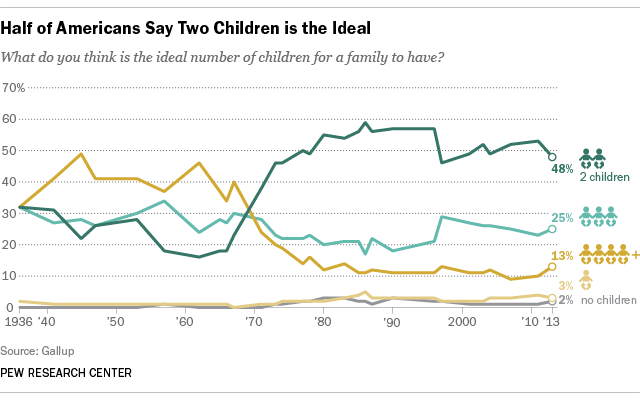
Truly late stage capitalism here.