You seem to intentionally be ignoring the original quote that any error may have caused them to be flung into space. This is patently false unless the one math error is pumping in hundreds of pounds more propellant and burning far longer than the scheduled burns. NASA would need to make a significant series of mistakes beyond orbital math for the "flung out into space" statement to be true.
They certainly could've gotten the return wrong but with a perigee of 119 miles they arent even in a stable orbit and likely could deorbit themselves using only rcs thrusters at apogee, or by just waiting a few orbits.
This is underselling the risks. On top of the many trajectories which push them into unrecoverable situations, leaving them stranded in orbit, there can be trajectories where the moon gives a gravity assist strong enough to fling the spacecraft into escape velocity, fulfilling the OP.
In fact, the trajectory they chose for this mission exploited the opposite effect to yield a free return without propellant expense.
In the modern day, the chance of a math error being the root cause behind this failure mode are vanishingly small, but minor burn execution mistakes that do not require hundreds of extra pounds of propellant are definitely plausible. They were extremely common in the early days of spaceflight and plagued most of the very first moon exploration attempts. Again, with modern RCS this is unlikely. But reentry is still incredibly tight and dangerous. Apollo famously had a +-1° safe entry corridor, and Orion is way heavier and coming in even faster. If their perigee was off they could’ve easily burned up or doubled their mission time, which they may not have been able to survive.
The amount of things that would have to go wrong for the craft to get an accidental gravity boost and be ejected would be significant.
I feel like the original claim paints the whole thing as on a knife edge and barely achieved by virtue of not making a single mistake. In today's age with so many moon landing deniers and worse I feel like we should be specific about where the actual dangers challenges and unknowns there were here. In reality, the orbital mechanics are one of the simplest parts of the entire problem, at least when we're talking about a moon flyby
Yes, this is a fair point. I agree that orbital mechanics is trivially easy compared to everything else. The chances of a math mistake in particular are null, these trajectories have all been calculated years in advance.
The moon's gravity turns out to be "lumpy" because its density is not constant. This was detected by the Apollo missions and caused them to make errors in orbit calculations. This source of error could have influenced the flyby.
I just did this to my MacBook not because of the sharp edge but because the pitting turns a sharp edge into a sawblade. Something about the grounding on on the frame when plugged in mixed with my sweaty hands leads to damage along this sharp edge on every MacBook I've ever owned.
Oh is that why it happens? Was wondering why the spot directly under my wrist was pitted into a sawblade. I also filed it, though just enough to remove the pitting, nothing like the OP did.
It's easy for me to feel the mains frequency while gently rubbing the top surface of the MacBook while it's plugged in. Really feels unsafe, but neither me nor the computer have suffered any serious injuries yet.
Really feels unsafe, but neither me nor the computer have suffered any serious injuries yet.
That's due to interference suppression capacitor in the PSU. The safety standard puts the "touch current" limit at something like 300uA (0.3mA), which is definitely in "painful but not dangerous" territory. You do need to exercise caution when plugging in other devices that are also connected to the mains, since that amount of current and voltage can certainly damage sensitive electronics.
I have super dry skin and I also feel that weird ac effect when lightly touching and moving along the surface of pretty much any aluminum mac device since they started making them aluminum.
And almost no other device I've ever used. My aluminum Framework does not do it. My wifes magnesium LG Gram does not do it.
I have felt it on other things but only extremely rarely. It's bizarre that whatever it is they're doing different, it's probably wrong, and they've kept doing it in every device for decades.
To describe the effect in more detail for anyone who doesn't already know: It's like the case is alternately grabbing and releasing your skin at 60hz.
It's a bit like chatter, ie the periodic friction you use to ring a wine glass by wetting the rim and then running your finger along it. It rings because the combination of the friction, the lack of friction from hydroplaning, and the rubbery give of your skin, makes your skin alternately grab and release 30,000 times a second. Only in this case you are only barely touching the case not pressing enough to make any friction or make a squeal noise. It's like static electric charge attraction. Just touching the case you feel nothing, but move your finger along the surface and you feel it vibrate your finger without any friction to explain it.
It's unsettling and displeasing, which are strange words to expect from an apple device at least when you are only talking about the design and not the tech stack or corporate behavior. It makes me think of cheap electronics from a country with no consumer safety regulations that will probably burn down every 3rd house they wind up in.
It's probably harmless, but then again a lot of things that are harmless in short infrequent doses turn out to have been harmful after you did it for 10 hours a day for 20 years.
They can’t, it’s caused by the capacitors required to suppress electromagnetic interference caused by the switch-mode power supply. These allow a very very tiny amount of current to leak through from the mains side, which is then capacitively coupled to the metal case (IIRC Apple do not connect the case to power negative) reducing it further, but it’s enough for humans to sense it.
It can be avoided by using a grounded power supply, but because there are large countries that have ungrounded outlets in common use the most designs are ungrounded.
Why do only Macbooks suffer from this problem? When I had a work-issued Macbook I charged it and my personal Framework off the same USB-C charger and I only every felt the leaking current from the Macbook
It's not only mac's suffering from this problem. My old dell latitude with magnesium case had the same thing. I didn't fully understand why and some people thought I was mad for feeling it but it was there.
Only Apple is insane enough to make actual laptop chassis with unpainted anodized aluminum. Others either do it in plastics and/or painted metal. And paints are kind of liquid plastics.
It’ll depend on how well grounded you are compared to how well grounded the laptop is, where it’s touching your body, and your sensitivity to electricity which varies.
Definitely been a long standing issue on many laptops with exposed metal parts. Late 90’s, if I used my brother’s Compaq while putting my feet up on the radiator, the metal speaker grills would give me mild shocks.
I once had an HP with an aluminum case and it had a grounded power supply but if you plugged it in without grounding his an adapter (sometimes you gotta do what you gotta do). You could feel it straight up vibrate while conducting current if you rubbed your hand over it. Not enough to shock me but it felt like kind of a shoddy design and leaked a lot more current than I've felt on a MacBook.
Is that what it is! On my pre-unibody MBP I used to run my finger across the body sometimes and it had this weird wavy feeling (honestly can't describe it well). I thought it was just a quirk of the aluminium itself!
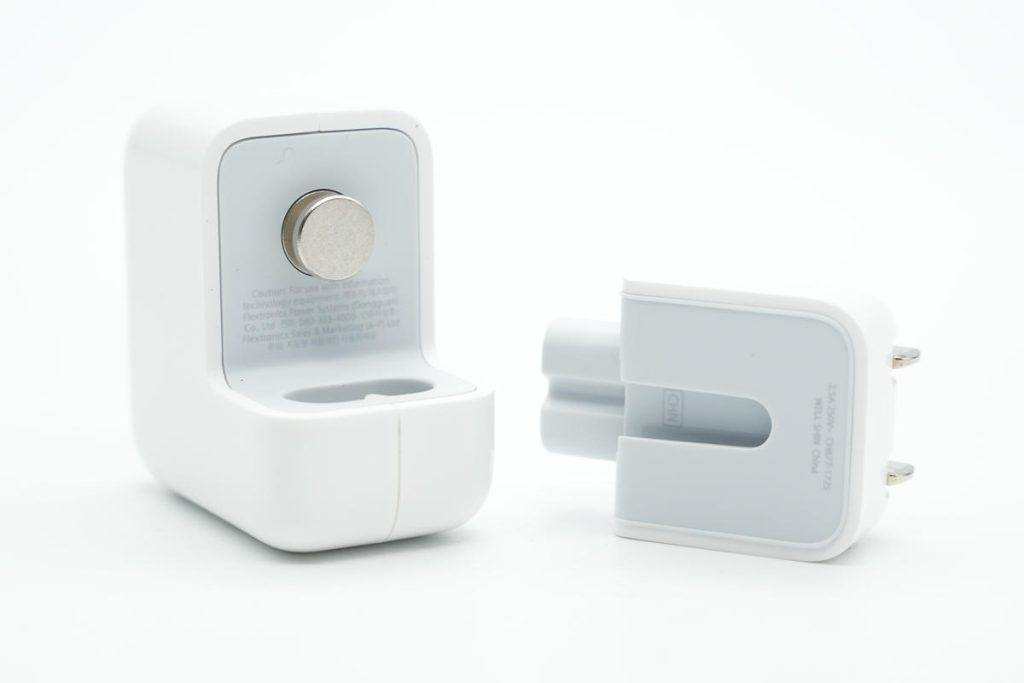
You can fix it by switching to one of the grounded charger heads. Unfortunately in most locales those are only available with an integrated extension cable (or as everyone seems to call them, the "gooseneck" cables)
It happens with other 2-pin chargers on both MacBooks and other laptops, but it depends upon various factors how strong the leakage is
It's also an issue on the new Neo. It was the first thing I noticed when I tried one in the Apple Store. I unplugged the power cable and it went away, replugged and it came back. I'm in the UK so I expected grounded electricity supply.
If you buy the UK 1.8-metre Power Adapter Extension Cable, this has a metal ground pin that grounds through the metal clip on the power brick. I switched all my MacBook & iPad chargers to this, no more earth leakage sensation from metal casing.
You wouldn't have this if your plug was properly grounded. Most developed countries have plugs that have grounding. EU via side pins UK via third prong
To add to this, I notice this more frequently in the UK and EU countries than in some other parts of the world (although it varies within each country quite a bit).
Apple avoids shipping grounded plugs as if it was personal affront to Ive. Also caused many many times for me to be shocked with electrostatic build-up.
> all my EU/UK macbook plugs I got from apple are always grounded, metal prong and metal side pins
The short version, where you remove the extension with the 3-prong plug and attach the plug directly to the charger brick, is only available in 2-prong in the EU/US (the UK thankfully still gets all 3 prongs in this configuration)
There are grounded duckheads for this purpose, e.g. https://amzn.to/4cnzuef (note out of stock. I guess your best bet is to use a UK duckhead, but half of those have a dummy ground...)
if you take the plug part from the brick you'll note that there's only two pins but the button-like thing is a ground
There's zero chance that the DC ground in the laptop is tied to earth ground in the charger: they use LLC resonant converters and flyback converters (depending on vintage) - an earth ground tie would defeat the purpose of these isolated topologies.
Probably. But, the time when the laptop is taped off would be uniquely a good time to hit it with some polyurethane or something clear to protect it from that sort of damage? Just make sure you hit it with compressed air first so you aren't gluing the aluminum dust to the chassis?
Yes but anodization implies thickness around ~5–25 micrometers (µm) for aluminum. The natural oxide coating is ~2-5 nanometers (1,000–5,000× less thick).
True; however, this is an aluminium alloy. These typically have lower corrosion resistance and are most commonly anodized because of it. The applied layer is typically 3 to 5x thicker than that formed by pure aluminium oxidization.
It’s extremely common and nothing to worry about. As a brass instrument player, I sometimes come across someone whose instruments always deteriorate at 300% of the rate of others. Laquer peels, silver plating blackens, etc.
I’ve been traveling around the world. It is 50 / 50 of the socket is properly grounded —-anywhere in the world. I get a tingling zap on the wrist when not properly grounded. The charger also gets hot and sparks.
Which makes it non-compliant in the UK, and no doubt elsewhere too. I don't understand how Apple (hardly a small fly-by-night!) continues to get away with it.
only two prongs of which make it through. Usually the regulation as I understand is that it's fine if you can prove the case can never get in contact with anything electric, for most laptops that's just being made of plastic.
The big recess above the pins is what encases the button of the charger and provides grounding if it includes metal strips. Assuming the charger itself has a metal button.
In the EU a grounded cable has been the default forever (I have a grounded cable from my 2010 MBP which I use as travel cable for my 2021 MBP)
That should not happen with a well designed power supply. It sounds like Apple cut some corners "for design reasons", or some shortcut to make it cheaper to manufacture.
Yes, it is fairly common with some plastics. better plastics won't but there are a lot of different plastics with differt formulas (and many can be mixed)
What's your concern here? That she lead nonprofits? She seems overly qualified to run a separate nonprofit to me.
Why would the government dump any programming language for anything non security related, let alone for the actions of a third party nonprofit? PHP is still governed my a committee of approved voters like always, not by the PHP foundation.
I've not used PHP in anger in well over a decade, but if the general environment out there is anything like it was back then there are likely a lot of people, mostly on cheap shared hosting arrangements, running PHP versions older than that and for the most part knowing no better.
That isn't the fault of the language of course, but a valid reason for some of the “ick” reaction some get when it is mentioned.
> languages like nodejs are far worse due to dependency rot
Yep. Node-based projects sometimes get an “ick” reaction from me similar to PHP ones for that reason. In this case it also isn't really the languages fault, but the way people have built the ecosystem around it.
You're forgetting that they are also training with real data from the 100+ million miles they've driven on real roads with riders, and using that data to train the world model AI.
> there's probably no examples in the training data where the car is behind a stopped car, and the driver pulls over to another lane and another car comes from behind and crashes into the driver because it didn't check its blindspot
A well designed dark mode UI is just as readable as a well designed light mode UI. The issue is a lot of designers design light mode then just try to invert for dark mode rather than actually designing for dark mode. I'd imagine your post would exist for light mode if we had started with dark mode as the default.
A lot of software is dark-mode first but it's still not right. Good dark schemes are just really hard to design, there are just too many nuanced differences. Color perception is maybe 10% of it. Typographics, line thickness, optical balance, accounting for massively increased contrast, antialiasing, layout, picture rendering, absolutely everything should be done differently on dark backgrounds.
And it depends too much on your environment, the type of display, and its pixel density, unlike in light mode which is way more forgiving to external factors.
It's not about outing ideology, it's about publishing personal information. And I believe privacy is a fundamental human right (yeah, bold take in this day and age but I'll die on that hill).
I agree with the rest of your point but I dont think its factual to say the majority of the country voted for trump. 77m/343m or ~20% of the country voted for trump, though I'm sure this is what you meant to say.
1. The majority of voters voted for Trump
2. People who don't vote are like fine with whoever wins like "What pizza? I'm fine with every pizza you bring"
False. Comment demonstrates ignorance of the electoral college and disregard for fact. Even among eligible voters who did vote, Trump got less than 50% of votes.
Majority means > 50%. Perhaps you meant plurality.
Regardless, US presidential elections do not depend on getting a majority or even a plurality of popular votes, but rather on a majority of electoral votes. And Trump did not get a majority of popular votes as claimed.
This being HN, the fact-check seemed appropriate and I stand by it.


They certainly could've gotten the return wrong but with a perigee of 119 miles they arent even in a stable orbit and likely could deorbit themselves using only rcs thrusters at apogee, or by just waiting a few orbits.
reply